
The FDA has no regulation specific to "energy drinks." The name came from the food industry. What the agency does publish is a range: generally 54–328 mg of caffeine per 16 fl oz, with a few brands at 41–246 mg per 12 fl oz. Most U.S. energy drinks list total caffeine from all sources, including ingredients such as guarana, on the label. [1]
On this page
A useful can is one whose milligrams you can add to the rest of the day. Sugar, taurine, and B vitamins show up below only when a label states them.
Caffeine by can
These are brand or retailer figures, not an Evident assay. Mayo Clinic's chart, separate from any brand, lists 79 mg for a generic 8 oz energy drink and 200 mg for a 2 oz energy shot. [2]
| Drink | Caffeine | Container | Source |
|---|---|---|---|
Red Bull Energy Drink | 80 mg | 8.4 fl oz | |
Red Bull Energy Drink | 114 mg | 12 fl oz | |
Red Bull Energy Drink | 151 mg | 16 fl oz | |
Red Bull Energy Drink | 198 mg | 20 fl oz | |
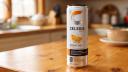 Celsius and Celsius Vibe | 200 mg | per can; the brand's daily cap is framed as two 12 oz cans | |
Celsius Essentials | 270 mg | per can | |
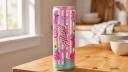 Alani Nu | 200 mg | 12 fl oz | |
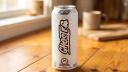 Ghost Energy, zero-sugar line | 200 mg | 16 oz |
Red Bull Energy Drink
Red Bull Energy Drink
Red Bull Energy Drink
Red Bull Energy Drink
Celsius and Celsius Vibe
Celsius Essentials
Alani Nu
Ghost Energy, zero-sugar line
Bars compare the labeled caffeine in this table, scaled to the highest amount here.
Product photos: AI composite from official product images. Product images: Celsius, Alani Nu, Ghost.
Celsius also sells On-The-Go powders at 200 mg per packet, and Hydration powders with no caffeine. [4] Those are easy to miss if you only count cans.
One can against the daily total
EFSA's 2015 opinion says single doses of caffeine up to 200 mg do not raise safety concerns for healthy adults who are not pregnant. The same 200 mg does not raise safety concerns when taken less than two hours before intense exercise under normal conditions. Habitual intake up to 400 mg a day does not raise safety concerns in that group. [7]
A 200 mg can is that entire single-dose figure. Celsius, Alani Nu's 12 oz can, and the Ghost zero-sugar 16 oz listing are each 200 mg. [4][5][6] Celsius Essentials at 270 mg is already above the single dose EFSA discussed. [4][7] Red Bull's 8.4 oz can is 80 mg, and its 20 oz can is 198 mg. [3] The container size is the dose.
The FDA has cited 400 mg a day for most adults as an amount not generally associated with negative effects, from all sources, not from energy drinks alone. [1] Two 200 mg cans are that whole day, before coffee or tea. Celsius says no more than two 12 oz cans a day, or one Essentials. [4] Alani Nu says no more than two cans a day, at least four hours apart. [5]
Other ingredients, only where a source is specific
EFSA looked at other ingredients common in these drinks. At the concentrations it called typical — about 300–320 mg/L of caffeine, 4,000 mg/L of taurine, and 2,400 mg/L of D-glucurono-γ-lactone — those ingredients would not change the conclusion for a single caffeine dose up to 200 mg. Alcohol up to about 0.65 g/kg body weight also would not change that single-dose conclusion. [7]
That is about those specific amounts. It does not mean every can matches them, and it is not a reason to use caffeine to stay alert while drinking. Sugar for these brands is on Healthiest Energy Drinks.
Children and pregnancy
The FDA, citing the American Academy of Pediatrics, says medical experts advise against energy drinks for children and teens because of the sugar and the caffeine. [1] EFSA said the evidence was not sufficient to derive a safe caffeine intake for children and adolescents. [7]
For pregnancy, EFSA says habitual caffeine up to 200 mg a day does not raise safety concerns for the fetus. For lactating women, single doses and habitual intakes up to 200 mg do not raise safety concerns for the breastfed infant. [7] The FDA's consumer update tells anyone pregnant, trying to become pregnant, or breastfeeding to talk with a clinician about limiting caffeine, rather than treating 400 mg as their number. [1] Alani Nu's own page says its energy drinks are not for anyone under 18, pregnant, or nursing. [5]
If the goal is focus, not a 200 mg can
One can is a large single dose. Coffee is still the default comparison: Mayo Clinic lists 96 mg in 8 oz brewed. [2] Stepping down is covered on Coffee Alternatives. The L-theanine-plus-caffeine studies people cite for a "smoother" effect used specific milligrams, not a can; those doses are on L-Theanine and Caffeine.
Pouches sold for focus are a different format, and many of them still contain caffeine. Whether the focus ingredients have a printed dose is the whole point of Best Focus Pouches.
References (7)
- U.S. Food and Drug Administration. Spilling the beans: how much caffeine is too much? Content current as of 28 August 2024. https://www.fda.gov/consumers/consumer-updates/spilling-beans-how-much-caffeine-too-much
- Mayo Clinic Staff. Caffeine content for coffee, tea, soda and more. 6 February 2025. https://www.mayoclinic.org/healthy-lifestyle/nutrition-and-healthy-eating/in-depth/caffeine/art-20049372
- Red Bull. How much caffeine is in a can of Red Bull Energy Drink? https://www.redbull.com/us-en/energydrink/questions/how-much-caffeine-is-in-a-can-of-red-bull-energy-drink
- Celsius. Essential facts. https://www.celsius.com/essential-facts/
- Alani Nu. Unfiltered: caffeine and consumption guidance. https://www.alaninu.com/pages/unfiltered
- Navy Exchange listing, Ghost zero sugar energy drink. https://www.mynavyexchange.com/ghost-zero-sugar-energy-drink/14145630
- EFSA Panel on Dietetic Products, Nutrition and Allergies. Scientific Opinion on the safety of caffeine. EFSA Journal. 2015;13(5):4102. https://doi.org/10.2903/j.efsa.2015.4102