
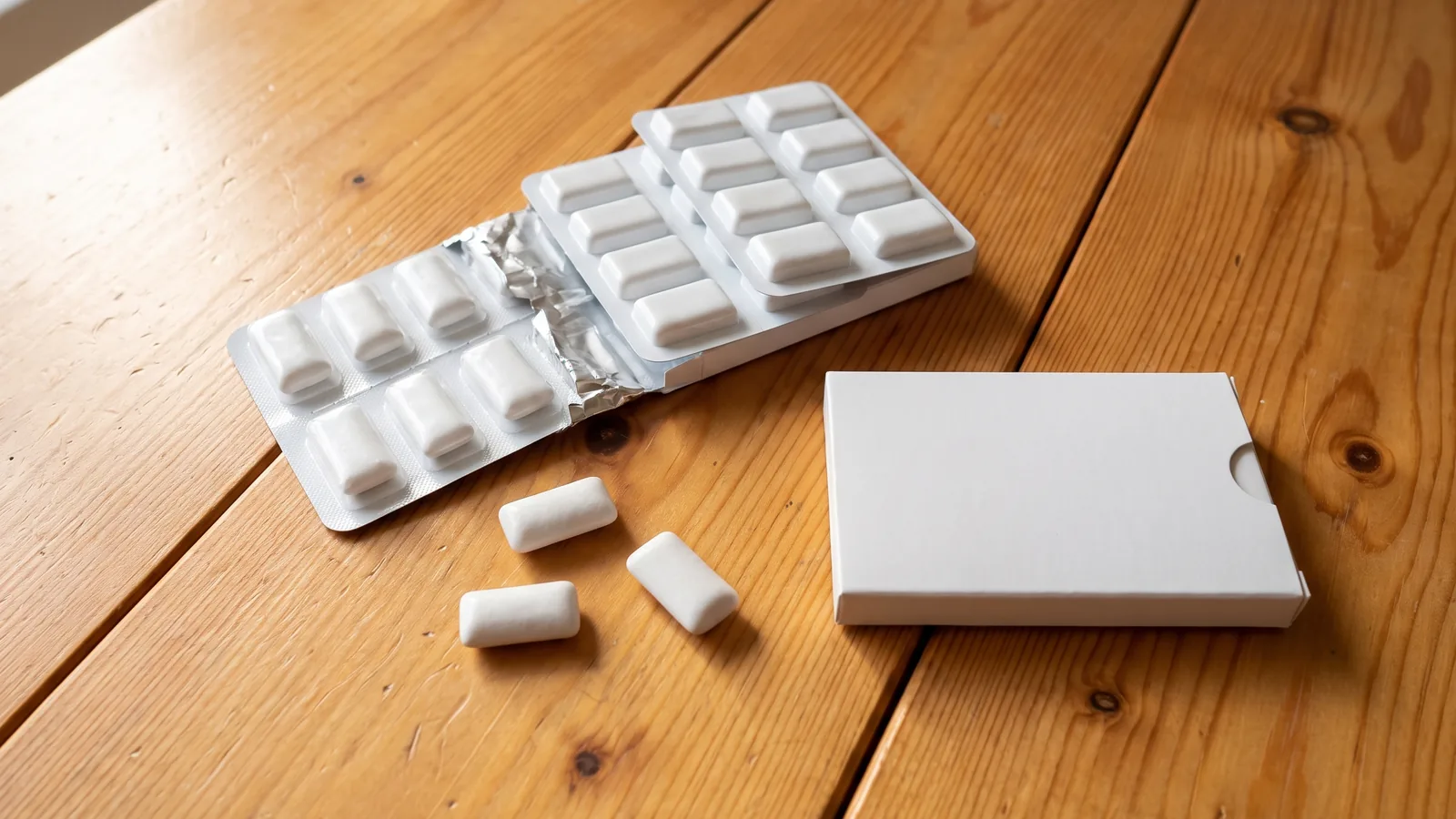
Caffeine gum is chewing gum with caffeine in it. It is one of the few formats, besides coffee, with a published comparison of blood levels against capsules. The U.S. military studied it as a ration. Brands differ in milligrams per piece, and in whether the label prints that number. [1][2]
On this page
How fast it reaches the blood
A 2002 study compared caffeine gum with capsules at 50, 100, and 200 mg. Each group was 12 healthy men who usually had under 300 mg of caffeine a day, had skipped caffeine for 20 hours, and had fasted for 3 hours. Gum reached its highest blood level in 44.2–80.4 minutes. Capsules took 84–120 minutes. At the same dose, the peak and the total amount absorbed were not different. [1][3]
Gum peaks sooner. That does not mean it is several times stronger, and it does not say how soon you will feel it. The study never reported a "5× faster than a drink" result, so that claim is not repeated here.
The same review says caffeine gum improved endurance cycling in the trials it covered. Evidence for repeated sprints and power was thinner. [1] The papers do not share one percentage, so this page does not invent one.
How much caffeine is in a piece
U.S. military ration gum contains 100 mg per piece. Commercial gums that print a number run from about 10 mg to 100 mg. Some labels only say "as much as a cup of coffee," which is not a dose, because coffee itself varies. [2]
| Gum | Caffeine per piece | What the label actually states | Source |
|---|---|---|---|
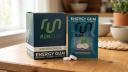 Run Gum | 50 mg | Two pieces per pack. The brand also lists taurine, vitamin B6, and vitamin B12, without milligrams. Directions say not to exceed eight pieces a day. | |
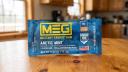 Military Energy Gum | 100 mg | The ingredient list leads with sugar and dextrose, then caffeine. The brand says the gum is NSF Certified for Sport. |
Run Gum
Military Energy Gum
Bars compare the labeled caffeine in this table, scaled to the highest amount here.
Product photos: AI composite from official product images. Product images: Run Gum, Military Energy Gum.
Other brands stay off this table until we have read their labels. Eight Run Gum pieces is 8 × 50 mg = 400 mg. That is the whole daily amount the FDA cites for most healthy adults, not a suggested serving. [4][6] Run Gum's Extra Strength is left out. Its product page did not give a clear milligram figure.
How the ration gum is meant to be used
For the gum in military rations, Operation Supplement Safety says to chew one piece for 5 minutes. If you are not alert within 15 minutes, chew a second. Do not exceed two pieces in 3 hours or eight pieces in 24 hours. [2] That piece count is for a 100 mg ration piece. A commercial gum at 50 mg or 10 mg is a different product, so the same count is not the same dose.
How much is too much
For most adults, the FDA has cited 400 mg of caffeine a day as an amount not generally associated with negative effects. Sensitivity varies. Pregnancy, some medicines, and some health conditions change that. [6]
EFSA's 2015 opinion says, for healthy adults who are not pregnant, that single doses up to 200 mg do not raise safety concerns, including when taken less than two hours before intense exercise under normal conditions. Habitual intake up to 400 mg a day does not raise safety concerns in that group. For pregnant women, habitual intake up to 200 mg a day does not raise safety concerns for the fetus. EFSA said the evidence was not sufficient to set a separate safe intake for children and adolescents. A single dose around 100 mg may affect sleep in some adults, especially close to bedtime. One piece of Military Energy Gum is already 100 mg. [5][7]
The FDA estimates that toxic effects such as seizures can occur with rapid consumption of around 1,200 mg. That is not a serving of gum. It is the reason to add gum to coffee, pouches, and energy drinks instead of treating the piece as separate from the rest of the day. [6]
Gum, pouches, and coffee
The blood-level curve we can cite is the gum-versus-capsule study. [1][3] We have not found a comparable published pharmacokinetic study for caffeine pouches, so this page does not call pouches faster or slower than gum. Coffee still has the longer record as a beverage. Mayo Clinic lists about 96 mg in 8 oz of brewed coffee. [8]
Pouches are a different product. Caffeine for the nicotine-free brands we compared is on Best Energy Pouches. Focus ingredients, and whether those milligrams are even printed, are on Best Focus Pouches.
What we have not tested
We have not lab-tested these pieces. The caffeine numbers are the brand's, or OPSS's, not an Evident assay. Run Gum lists sorbitol, mannitol, xylitol, and sucralose and does not show a nutrition panel, so sugar grams are not stated. Other gums stay off the table until their labels are in hand.
References (8)
- Wickham KA, Spriet LL. Administration of caffeine in alternate forms. Sports Medicine. 2018. https://pmc.ncbi.nlm.nih.gov/articles/PMC5790855/
- Operation Supplement Safety. Caffeinated gum: Q&A about the gum in your MREs. Updated 26 February 2019. https://www.opss.org/article/caffeinated-gum-qa-about-gum-your-mres
- Kamimori GH, Karyekar CS, Otterstetter R, et al. The rate of absorption and relative bioavailability of caffeine administered in chewing gum versus capsules to normal healthy volunteers. International Journal of Pharmaceutics. 2002;234:159–167. https://doi.org/10.1016/S0378-5173(01)00958-9
- Run Gum. Caffeine chewing gum. https://rungum.com/pages/caffeine-gum-by-rungum
- Military Energy Gum. MEG product page. https://militaryenergy.com/products/meg-military-energy-gum
- U.S. Food and Drug Administration. Spilling the beans: how much caffeine is too much? Content current as of 28 August 2024. https://www.fda.gov/consumers/consumer-updates/spilling-beans-how-much-caffeine-too-much
- EFSA Panel on Dietetic Products, Nutrition and Allergies. Scientific Opinion on the safety of caffeine. EFSA Journal. 2015;13(5):4102. https://doi.org/10.2903/j.efsa.2015.4102
- Mayo Clinic Staff. Caffeine content for coffee, tea, soda and more. 6 February 2025. https://www.mayoclinic.org/healthy-lifestyle/nutrition-and-healthy-eating/in-depth/caffeine/art-20049372