
Tatiana Mustafa
COM® · RDH
Published: October 27, 2026
This article is for educational purposes and isn't medical advice. Please talk to your own dentist, doctor or therapist about your situation.
Evident editorial note. This is the expert’s perspective and is not medical advice.
Video
This expert’s video will play here once a URL is added.
On this page
The short version
Your nose is built for breathing. It filters, warms and humidifies the air you breathe in, and it adds a little resistance that helps keep your airway stable while you sleep [1][3].
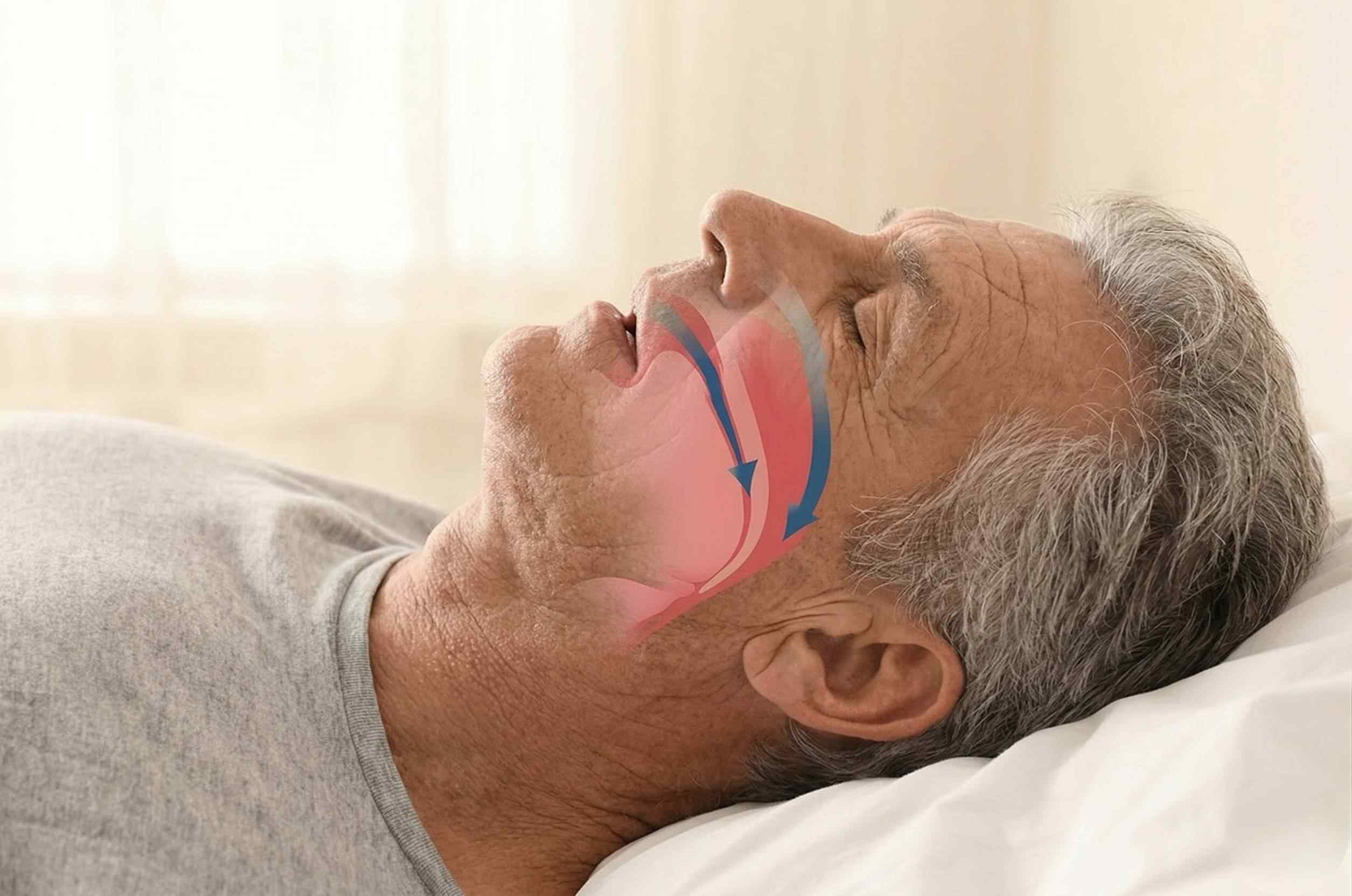
Chronic mouth breathing, especially at night, is linked to snoring and sleep-disordered breathing, a drier and more acidic mouth, gum inflammation and, in growing children, differences in how the jaws and face develop [3][4][5][6].
Two honest caveats before we go further. First, much of this evidence is observational or comes from small studies, so we can't always say mouth breathing causes these problems. Second, a blocked nose is very often the root cause. That's why, in my practice, the nose always comes first.
Why the nose is built for breathing

I like to think of the nose as the airway's front office. Before air ever reaches your lungs, your nose filters out particles, warms the air toward body temperature and adds moisture to it [1]. When you breathe through your mouth, you skip most of that preparation.
Air through the nose, before the lungs
Filters
Particles come out before air reaches the lungs.
Warms
Air moves toward body temperature.
Humidifies
The nose adds moisture.
Resistance
A little resistance is part of the design.
Nitric oxide: the nose's own messenger
Your paranasal sinuses produce nitric oxide, a gas that relaxes blood vessels. That nitric oxide is carried into the lungs with each breath, mainly when you breathe through your nose. In a small study, most healthy volunteers had slightly higher oxygen levels in their blood during nasal breathing than during mouth breathing [2]. It's an early, small finding, but it's a nice reminder that nasal breathing does more than move air.
Why a little resistance is a good thing
Breathing through your nose feels slightly "harder" than breathing through your mouth, and that's by design. The nose provides resistance to airflow [1], and the breathing route also changes how stable your airway is during sleep, which we'll look at next [3].
What mouth breathing does to your sleep
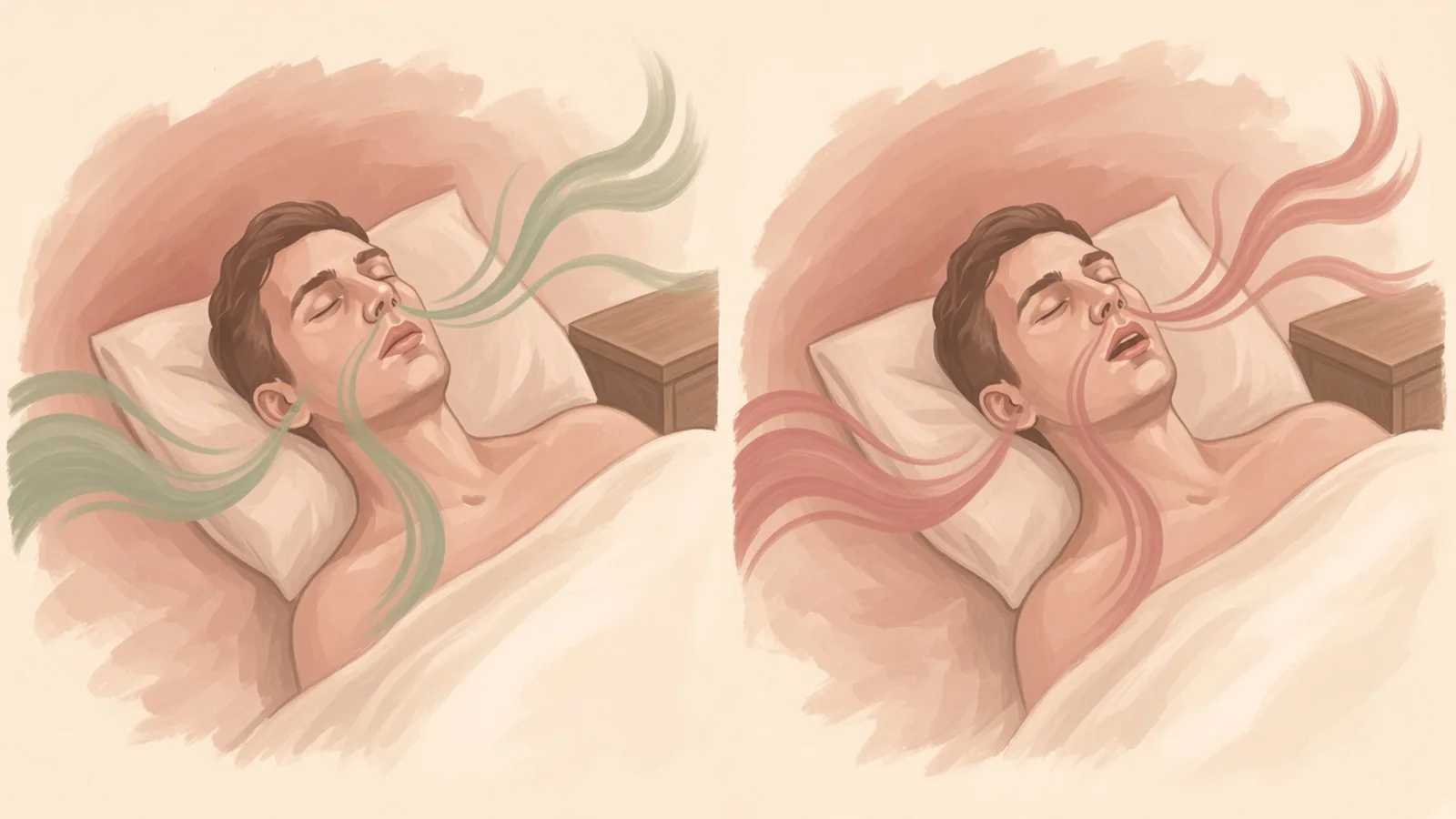
This is the part that surprises most of my patients. In a small crossover study, researchers had 12 healthy adults with normal noses sleep while breathing through their nose and, on another occasion, through their mouth. Awake, airway resistance was similar either way. Asleep, it was much higher with mouth breathing, and obstructive apneas and hypopneas (pauses and shallow breaths) were far more frequent: an average apnea-hypopnea index of 43 events per hour with mouth breathing versus 1.5 with nasal breathing [3].
Nasal breathing
1.5
Mouth breathing
43
Events per hour. Bars use the same scale.
In everyday terms, people who mouth-breathe at night often tell me about:
- Snoring
- A dry mouth or sore throat on waking
- Restless or fragmented sleep, and waking up tired
I want to be careful here. That study was small and experimental, and it forced mouth breathing in people who don't normally do it. In real life, mouth breathing is often a sign of a nasal or sleep problem as well as a contributor to it. If you snore loudly or wake up gasping, the first step is getting checked, not just changing a habit.
What mouth breathing does to your teeth and gums
As a dental hygienist, this is where I see mouth breathing most clearly.
A drier, more acidic mouth
Saliva protects your teeth. When your mouth hangs open all night, it dries out. In a small study, healthy volunteers wore a sensor behind their upper front teeth while sleeping, with and without a nose clip to simulate mouth breathing. Average intraoral pH during sleep fell from 7.0 to 6.6 with mouth breathing, and it stayed lower for longer [4]. A lower pH has been proposed as a contributor to enamel erosion and tooth decay [4].
More plaque and gum inflammation
In a study of 201 schoolchildren aged 11 to 14, mouth breathing was associated with more plaque and more gingival inflammation. The link was strongest in the upper front area of the mouth, particularly on the palate side behind the upper front teeth [5]. This was a single observational study in children, so it shows an association rather than proof of cause.
What I see in the chair
After 10 years working as a dental hygienist, I started noticing that the mouth often tells a much bigger story than just how well someone brushes and flosses. I'd see patients with red, inflamed gums, especially around the upper front teeth, dry mouths, worn-down teeth from clenching and grinding, and sometimes even unexplained bone loss despite good oral hygiene. What really caught my attention was learning how closely nighttime clenching and grinding can be associated with sleep-disordered breathing. Chronic grinding can also place excessive forces on the teeth and supporting structures, potentially contributing to periodontal damage in patients with existing gum disease. These patterns made me realize that sometimes what we're seeing in the mouth is a clue to what's happening with someone's breathing and sleep.
What mouth breathing does to the developing face in children

This is the question parents ask me most: can mouth breathing change my child's face?
A 2021 systematic review and meta-analysis pooled 10 studies comparing mouth-breathing and nasal-breathing children. On average, the mouth-breathing children showed [6]:
- A backward and downward rotation of the upper and lower jaws
- A steeper occlusal plane (the plane where the teeth meet)
- More forward-tipped upper front teeth
- Narrower airway measurements
These are real, measurable differences, but the limits matter. The studies were observational, and most of the children (6 of the 10 studies) were mouth-breathing because of enlarged adenoids or tonsils [6]. That makes it hard to separate the effect of mouth breathing from the effect of the obstruction behind it. There are a few twin studies that show the differences between one twin who was a nasal breather and the other a mouth breather. The differences are astounding.
My story: why I care about this
I didn't become a myofunctional therapist by accident. I spent years dealing with orthodontic problems myself. Even after braces and headgear from 8–10 years old, my teeth relapsed. I went through Invisalign at 26 years old, wore my retainer nightly afterwards and my teeth still shifted!! After researching why this would be happening I discovered myofunctional therapy. It was my myofunctional therapist, not an orthodontist or dentist, that told me I had a narrow palate and a tongue tie. At that time the only option for me was double jaw surgery, something I could not afford. Still, my journey through myofunctional therapy was so eye opening. I took everything I learned from my myofunctional therapist and applied it to my children, and all of them now have nice wide palates, their teeth are coming in straight and they have no airway issues! That is what made me realize I could not gatekeep this, and need to educate all parents about the importance of correct tongue posture and nasal breathing.
Fast forward a few years and now palate expansion is something that can be offered to adults. I went through MARPE expansion and my sleep quality has been drastically improved. I now have room for my tongue to fit on the roof of my mouth and it stays there all night! I use mouth tape to ensure my lips stay sealed, especially while still in Invisalign, because anything on your teeth can break the seal of your lips, and if your lips part, your tongue may drop down and then you are back to mouth breathing and a collapsed airway.
Why people mouth-breathe, and why the nose comes first
People rarely breathe through their mouth just because they want to. The most common reasons I see fall into a few groups:
- Nasal obstruction: a deviated septum, enlarged turbinates, or enlarged adenoids or tonsils [6]
- Allergies and congestion: chronic allergic rhinitis is one of the causes studied [6]
- Habit: sometimes the mouth-breathing pattern stays after the original cause is gone
- Restricted tongue mobility: a tongue tie can make it harder to rest the tongue on the palate and keep the lips closed
Here's the key point. If you physically can't breathe comfortably through your nose, no amount of habit training will fix that. Exercises can't open a blocked airway. That's why I always want the nose checked first, by an ENT if needed, before we work on habits.
If you physically can't breathe comfortably through your nose, no amount of habit training will fix that.
What a myofunctional therapist assesses, and where the evidence is
When someone comes to see me, I look at:
- Resting tongue posture: where the tongue sits when you're not talking or eating
- Lip seal: whether the lips rest closed comfortably
- Swallow pattern: how the tongue and facial muscles work when you swallow
- Breathing route: nasal versus mouth breathing, during the day and at night
Where the evidence is strongest
The best-studied use of myofunctional therapy is obstructive sleep apnea. A 2015 systematic review and meta-analysis found that in adults, the apnea-hypopnea index fell by roughly 50% (from an average of 24.5 to 12.3 events per hour), and in children by roughly 62%, with snoring and daytime sleepiness improving too [7]. Myofunctional therapy is best thought of as an adjunct alongside other sleep apnea treatment, not a replacement for it.
What's less proven
The studies behind that review were small. And the bigger claims you'll see online, such as tongue posture alone reshaping an adult's face, aren't supported by the research I've described here, because that is something so hard to measure in a clinical, research setting. I can say that every single one of my patients has notable differences before and after myofunctional therapy.
How to retrain nasal breathing
Retraining nasal breathing is a step-by-step process. Here's the order I follow with my patients:
- Clear the nose first. Get any obstruction, allergies or chronic congestion assessed and treated.
- Build daytime awareness. Notice when your mouth is open while reading, working or watching TV, and gently close it.
- Practise lip seal and tongue posture. Guided exercises help the lips rest closed and the tongue rest on the palate, which makes nasal breathing feel more natural.
- Then look at nighttime. Night habits usually follow daytime ones, but they take longer to change.
A note on mouth taping
You've probably seen mouth taping on social media. The research is limited. A 2025 systematic review found only 10 small studies with 213 patients in total. Two showed improvements in sleep apnea markers, others showed no difference, and the authors warned of a potentially serious risk of harm when people tape indiscriminately, particularly with a blocked nose [8]. A small preliminary study of 20 mouth-breathers with mild sleep apnea, without a control group, found snoring and apnea-hypopnea index dropped by roughly half over a week [9].
My view: it isn't something to try on your own. If you're curious, discuss it with a professional who has assessed you first. It shouldn't be tried by anyone with suspected or untreated sleep apnea, a blocked or congested nose, or difficulty breathing comfortably through the nose, or by children.
I personally do use mouth tape and want to share my experience with you. Anything on your teeth is going to weaken your lip seal. Invisalign, braces, or mouth guards. I currently have Invisalign trays, so I wear a strip of mouth tape over my lips to help keep the seal. I have noticed that on nights that I forget to wear my mouth tape my lips will part, causing my mouth to fall open, and my tongue to fall down in the back of my airway space, which causes me restless sleep. I don’t have sleep apnea, but if my mouth is open, I have a lot of sleep disturbances that cause me to toss and turn and even briefly wake up.
When to see whom
Mouth breathing sits between several specialties, so here's a simple guide:
- ENT (ear, nose and throat) doctor: a nose that's often blocked, or suspected enlarged adenoids or tonsils
- Sleep physician: loud snoring, gasping, pauses in breathing or daytime sleepiness
- Dentist or orthodontist: gum inflammation, enamel changes, bite changes or questions about a child's jaw development
- Myofunctional therapist: tongue posture, lip seal, swallowing and retraining nasal breathing
The bottom line
Your nose is designed to be your main airway, day and night. Chronic mouth breathing is linked to poorer sleep, a drier and more acidic mouth, gum inflammation and differences in children's facial development, though much of the evidence is observational. The most important step is finding out why you mouth-breathe. Start with the nose, then work on habits with the right professional.
Frequently asked questions
Is mouth breathing bad for you?
Yes! Mouth breathing is bad for you. Chronic mouth breathing can negatively affect your health, especially in children whose jaws and faces are still developing. Our bodies are designed to breathe primarily through the nose. Nasal breathing helps filter, warm, and humidify the air we breathe. Chronic mouth breathing can contribute to: dry mouth, cavities and gum inflammation; snoring and disrupted sleep; poor tongue resting posture; changes in jaw and facial development in growing children; and an increased risk of certain orthodontic problems, including narrow dental arches and crowded teeth [3][4][5][6].
Why do I breathe through my mouth when I sleep?
Most often because your nose isn't working well enough, from congestion, allergies, a deviated septum, enlarged turbinates, or enlarged adenoids or tonsils [6]. Habit and tongue posture can play a role too, as well as anything covering the teeth like retainers and night guards.
How do I stop mouth breathing at night?
Start by getting your nose assessed. Then build daytime nasal breathing, lip seal and tongue posture with guidance from a myofunctional therapist. Nighttime habits usually follow.
Can mouth breathing change your face?
In children, mouth breathing is associated with backward and downward jaw rotation and more forward-tipped upper front teeth [6]. Essentially, a recessed chin and buck teeth. In adults who mouth breathe we tend to see saggier looking faces, double chins (not from being overweight, but from the tongue resting low and pushing down on the muscle of the chin), dark circles under the eyes and smile lines. Once we correct the mouth breathing, we tend to see improvements in aesthetics, even though that is not the goal of myofunctional therapy.
Is mouth taping safe?
The evidence is limited and mixed, and researchers have raised safety concerns, especially for anyone with a blocked nose [8][9]. Talk to a professional before trying it.
Can adults switch to nasal breathing?
Many adults can, once any obstruction is treated. Retraining takes consistent practice, and a myofunctional therapist can guide you through it.
About the author
Tatiana Mustafa, COM®, RDH, is a certified orofacial myologist and former dental hygienist with over a decade of experience in oral health. Her passion for myofunctional therapy began with her own journey to better breathing, sleep, and oral function which completely changed the way she looks at the mouth.
Today, Tatiana runs a thriving myofunctional therapy practice in Goleta, California, while also working virtually with patients around the world. She helps children and adults uncover and correct dysfunctional oral habits, including mouth breathing, improper tongue posture, poor lip seal, and incorrect swallowing patterns.
Tatiana’s mission is to help people understand that the way we breathe, swallow, and position our tongues matters far more than most people realize.
Follow her on Instagram @faceforwardmyo, where she shares practical tips, eye-opening education, and simple ways to improve oral function. Or check out her website: goletamyoworks.com for more information about myofunctional therapy.
References (9)
- Sahin-Yilmaz A, Naclerio RM. Anatomy and physiology of the upper airway. Proc Am Thorac Soc. 2011;8(1):31–39. PubMed: https://pubmed.ncbi.nlm.nih.gov/21364219/
- Lundberg JO, Settergren G, Gelinder S, Lundberg JM, Alving K, Weitzberg E. Inhalation of nasally derived nitric oxide modulates pulmonary function in humans. Acta Physiol Scand. 1996;158(4):343–347. PubMed: https://pubmed.ncbi.nlm.nih.gov/8971255/
- Fitzpatrick MF, McLean H, Urton AM, Tan A, O'Donnell D, Driver HS. Effect of nasal or oral breathing route on upper airway resistance during sleep. Eur Respir J. 2003;22(5):827–832. PubMed: https://pubmed.ncbi.nlm.nih.gov/14621092/
- Choi JE, Waddell JN, Lyons KM, Kieser JA. Intraoral pH and temperature during sleep with and without mouth breathing. J Oral Rehabil. 2016;43(5):356–363. PubMed: https://pubmed.ncbi.nlm.nih.gov/26666708/
- Wagaiyu EG, Ashley FP. Mouthbreathing, lip seal and upper lip coverage and their relationship with gingival inflammation in 11–14 year-old schoolchildren. J Clin Periodontol. 1991;18(9):698–702. PubMed: https://pubmed.ncbi.nlm.nih.gov/1820769/
- Zhao Z, Zheng L, Huang X, Li C, Liu J, Hu Y. Effects of mouth breathing on facial skeletal development in children: a systematic review and meta-analysis. BMC Oral Health. 2021;21:108. PubMed: https://pubmed.ncbi.nlm.nih.gov/33691678/
- Camacho M, Certal V, Abdullatif J, et al. Myofunctional therapy to treat obstructive sleep apnea: a systematic review and meta-analysis. Sleep. 2015;38(5):669–675. PubMed: https://pubmed.ncbi.nlm.nih.gov/25348130/
- Rhee J, Iansavitchene A, Mannala S, Graham ME, Rotenberg B. Breaking social media fads and uncovering the safety and efficacy of mouth taping in patients with mouth breathing, sleep disordered breathing, or obstructive sleep apnea: a systematic review. PLOS ONE. 2025;20(5):e0323643. PubMed: https://pubmed.ncbi.nlm.nih.gov/40397877/
- Lee YC, Lu CT, Cheng WN, Li HY. The impact of mouth-taping in mouth-breathers with mild obstructive sleep apnea: a preliminary study. Healthcare (Basel). 2022;10(9):1755. PubMed: https://pubmed.ncbi.nlm.nih.gov/36141367/