
Best Ceylon Cinnamon
How a label tells Ceylon from cassia, and what German and European risk assessments say about coumarin. This is not a blood-sugar guide, and it does not name a brand.
Quick Summary
The useful line on a cinnamon label is the botanical name. Cassia carries the coumarin. Ceylon, in the measurements regulators cite, has traces or none. We are not ranking brands, and we are not using an unverified search-growth claim.
Ceylon versus cassia
“Cinnamon” on a jar can be more than one tree. Ceylon cinnamon, also called true cinnamon, is Cinnamomum verum (older name Cinnamomum zeylanicum). The common grocery bark is usually cassia, including Cinnamomum cassia and related species. They taste different. They are not interchangeable on coumarin.
The German Federal Institute for Risk Assessment (BfR), in its 2006 health assessment of high cinnamon intakes, wrote that unlike cassia, Ceylon cinnamon hardly contains any coumarin. Measurements in cinnamon capsules, which BfR attributed to cassia, were about 2,100 to 4,400 mg of coumarin per kilogram of powder. In Ceylon cinnamon, coumarin was found only in traces or below the measurement limit. BfR also notes that the two can be distinguished chemically: Ceylon contains eugenol and benzyl benzoate, and at most traces of coumarin.
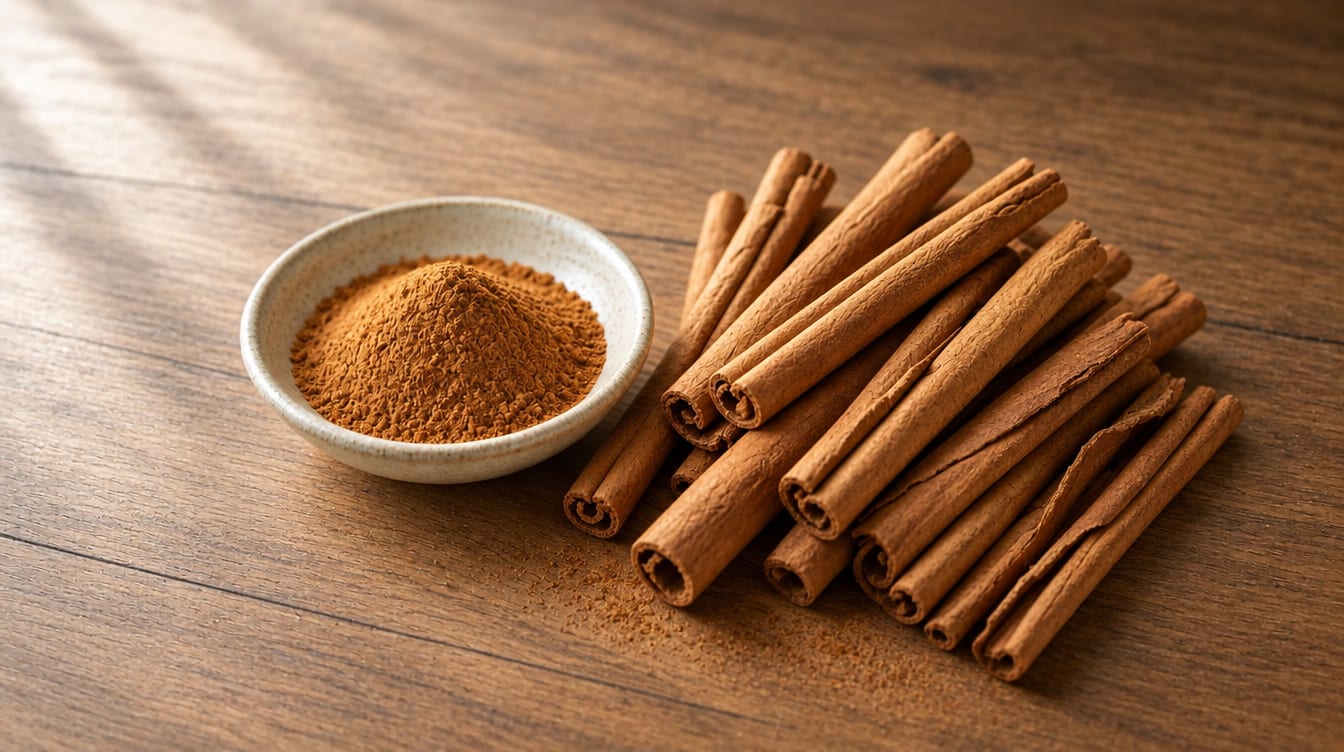
A quill’s shape is a clue grocers use and a poor lab test. The photograph on this page shows cinnamon bark and powder. We did not authenticate the species. Read the Latin name on the package.
Coumarin
Coumarin can damage the liver. BfR’s FAQ says animal experiments, and use as a drug in sensitive people, showed that risk. BfR and the European Food Safety Authority use the same tolerable daily intake: 0.1 mg of coumarin per kilogram of body weight per day. BfR’s example is a 60 kg adult, for whom that is 6 mg a day, over a lifetime. The FAQ says exceeding that value in the short run does not pose a health risk. Gram-level daily use of cassia, which is what some capsule directions have suggested, is a different exposure than a sprinkle on food.
BfR’s practical point for capsules: if the powder is cassia, the coumarin intake can pass the tolerable intake at the amounts on some labels. One option BfR names is replacing cassia with Ceylon. It also says it was not established that Ceylon would have the same effect some sellers were claiming for cassia. This page does not repeat those claims. Cinnamon is not a treatment.
A label that says “Ceylon” without Cinnamomum verum, or that says only “cinnamon,” does not tell you the coumarin side of this. A certificate that reports coumarin, or that identifies the species, is the document. “True cinnamon” as a marketing line is not that document.
How to read a cinnamon supplement label
- Botanical name: Cinnamomum verum or C. zeylanicum for Ceylon. C. cassia, C. burmannii, or C. loureiroi are cassia types.
- Form: powdered bark, an aqueous extract, or a blend. BfR noted that aqueous extracts of cassia had far lower coumarin in the Stuttgart measurements it cited. An extract is still not a species name.
- Milligrams of cinnamon material per serving, and the suggested number of servings. Coumarin intake is amount times concentration.
- We did not open a primary study of “fake cinnamon” fraud rates for this page, so none is printed.
- No brand and no price. We did not open shop pages for this guide.
Ceylon cinnamon side effects
The documented issue in the BfR file is coumarin and the liver, and it attaches to cassia far more than to Ceylon. Ceylon is not a free pass: a supplement can still be mislabeled, and any concentrated botanical can disagree with a medicine. We are not quoting a side-effect percentage for Ceylon capsules. We did not open a trial that reported one in a way we could cite here.
People with liver disease, and anyone taking several grams of cinnamon powder a day, should treat the coumarin math as a reason to ask a clinician and to check which species is in the bottle. That is exposure advice from the risk assessments above, not a claim that cinnamon improves blood sugar.
Search interest is large and steady
Ahrefs’ estimate of US monthly searches for “ceylon cinnamon” was 69,256 in October 2025 and 74,362 in October 2026. That is about 7% higher, year over year. We checked that history on November 3, 2026. It is not a sudden spike.
Our verdict
If the goal is less coumarin, the label has to name Ceylon cinnamon, Cinnamomum verum, and ideally back that up with a test. Cassia is the bark with the coumarin numbers in the BfR file. We are not choosing a brand, and we are not assigning cinnamon a medical job.
Sources
How we checked
On November 3, 2026 we read the BfR coumarin FAQ and the 2006 BfR cinnamon assessment. The 2,100 to 4,400 mg/kg range, the trace finding for Ceylon, the 0.1 mg/kg tolerable intake, and the 6 mg example for a 60 kg adult are from those documents.
Ahrefs US monthly search volume for “ceylon cinnamon” was pulled the same day for October 2025 through October 2026. The year-over-year change from October to October is about 7%.
No brand pages were opened. Evident did not test cinnamon. No affiliate links.
Frequently Asked Questions
We are not naming a brand. Look for Cinnamomum verum or Cinnamomum zeylanicum, a stated milligram amount, and a test that identifies the species or reports coumarin. “Cinnamon” alone is not that.
They are different species. BfR reports that cassia powder contains substantial coumarin, on the order of 2,100 to 4,400 mg/kg in the capsule measurements it reviewed, while Ceylon cinnamon had only traces or amounts below the measurement limit.
BfR and EFSA use 0.1 mg of coumarin per kilogram of body weight per day as a tolerable daily intake. BfR’s example for a 60 kg adult is 6 mg a day. The agency says a short-term exceedance is not the same as a lifetime exposure at that level.
The liver concern in the risk assessments is coumarin, which those assessments tie to cassia rather than to Ceylon. This page does not quote a side-effect rate for Ceylon supplements. People with liver disease should ask a clinician before using gram-level cinnamon powders.
Related reading
Most read in Herbal

Explore
This is an evidence review, not medical advice and not a recommendation to use cinnamon for any condition. Evident did not test cinnamon products and uses no affiliate links.