Mouth Tape for CPAP Users: What Actually Works With a Machine
CPAP can feel like it is failing when air leaks through the mouth. You wear the mask. You deal with the noise. You do everything right. You can still wake up with dry mouth. Mouth tape is not a treatment for sleep apnea, and it is not a reason to stop CPAP.

Mouth Tape and CPAP Mouth Leak: What Research Says — and What It Doesn’t
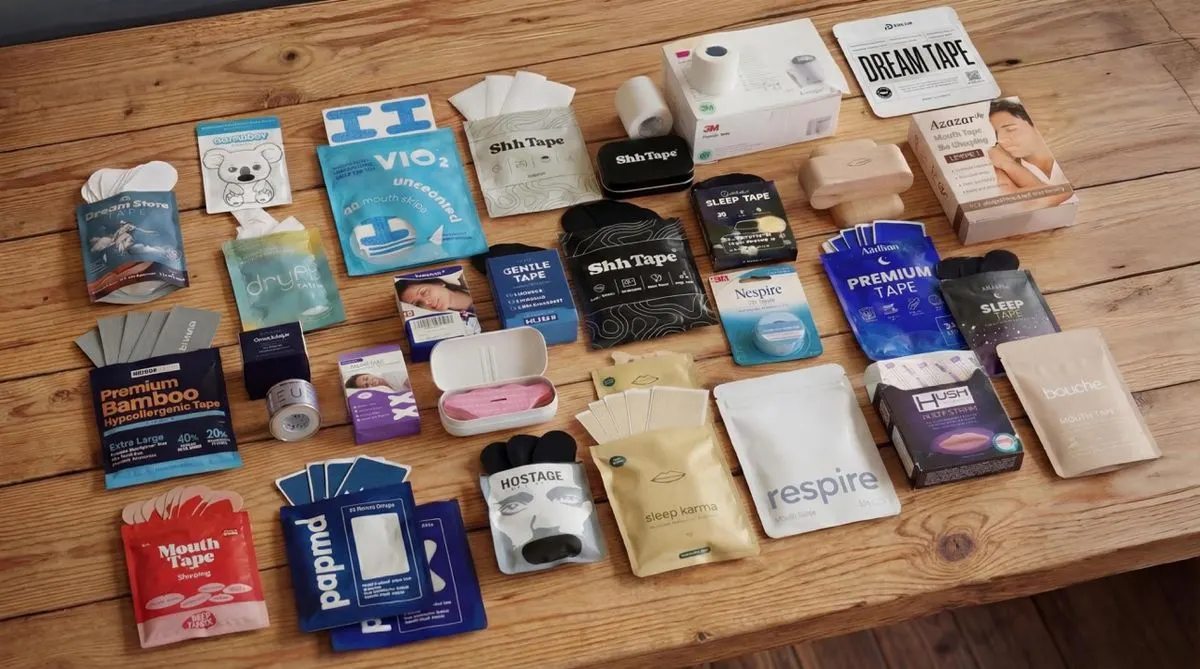
Mouth leak is a common reason CPAP feels like it is failing. Nasal breathing is linked in the literature to a more stable jaw position. Mouth tape is a consumer sleep-hygiene product some people try with a clinician — not a treatment for sleep apnea and not a reason to stop CPAP. 46 brands researched and scored, 7 recommended.


7 Things Every CPAP User Needs to Know
You’ve Tried Everything. Your Leak Rate Won’t Budge.
New mask. Different pillows. Chin strap. Heated humidifier turned to max. You’ve done everything the sleep tech told you to do and you still wake up at 3am with a mouth so dry it hurts to swallow. Your OSCAR data tells the story: leak rate spiking every time you hit deep sleep.
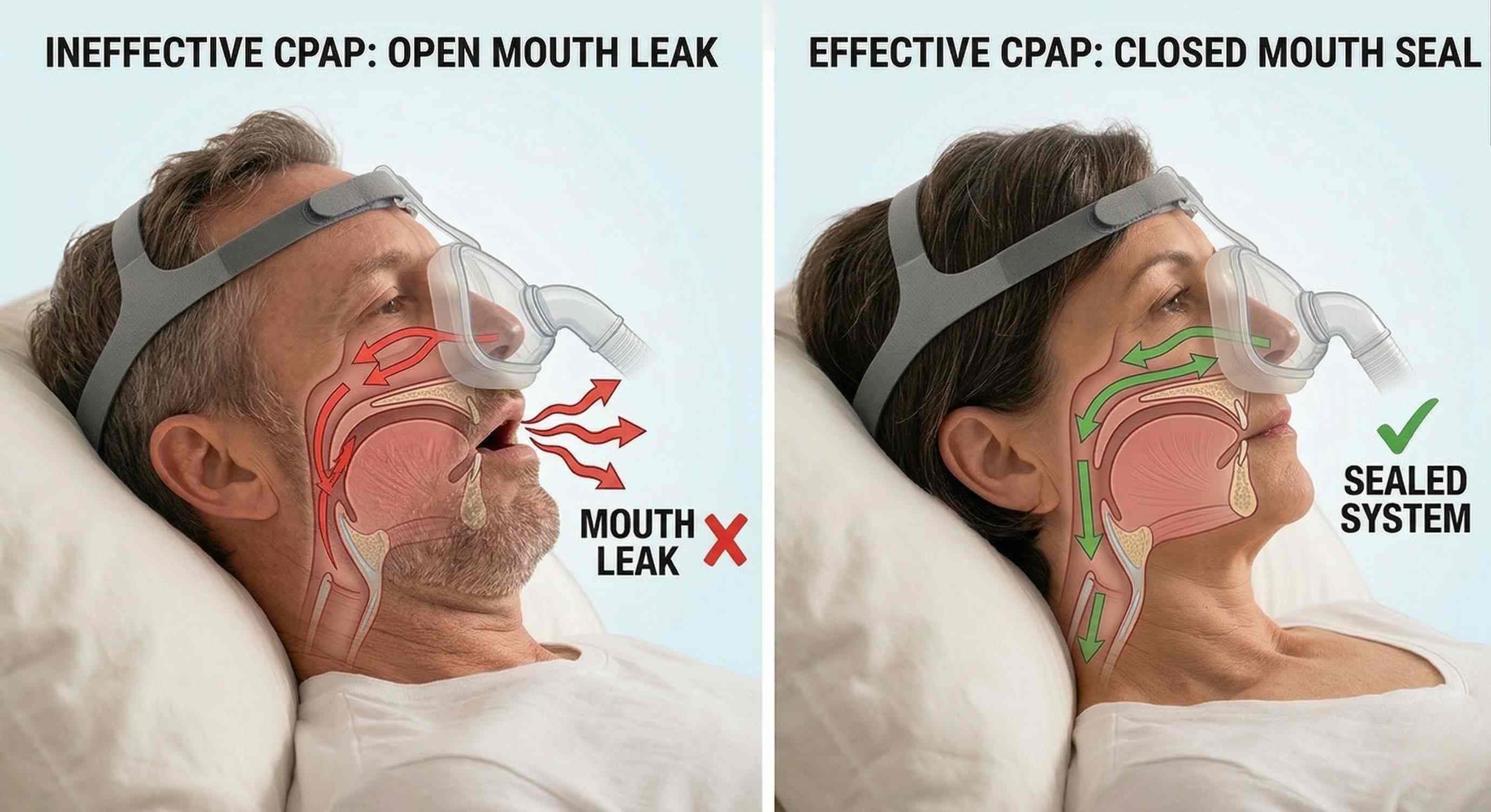
Here’s what nobody explained clearly enough: your CPAP is working fine. Your mouth is defeating it. The moment your jaw relaxes, your lips part, and every pound of pressure your machine delivers escapes straight out through the gap.
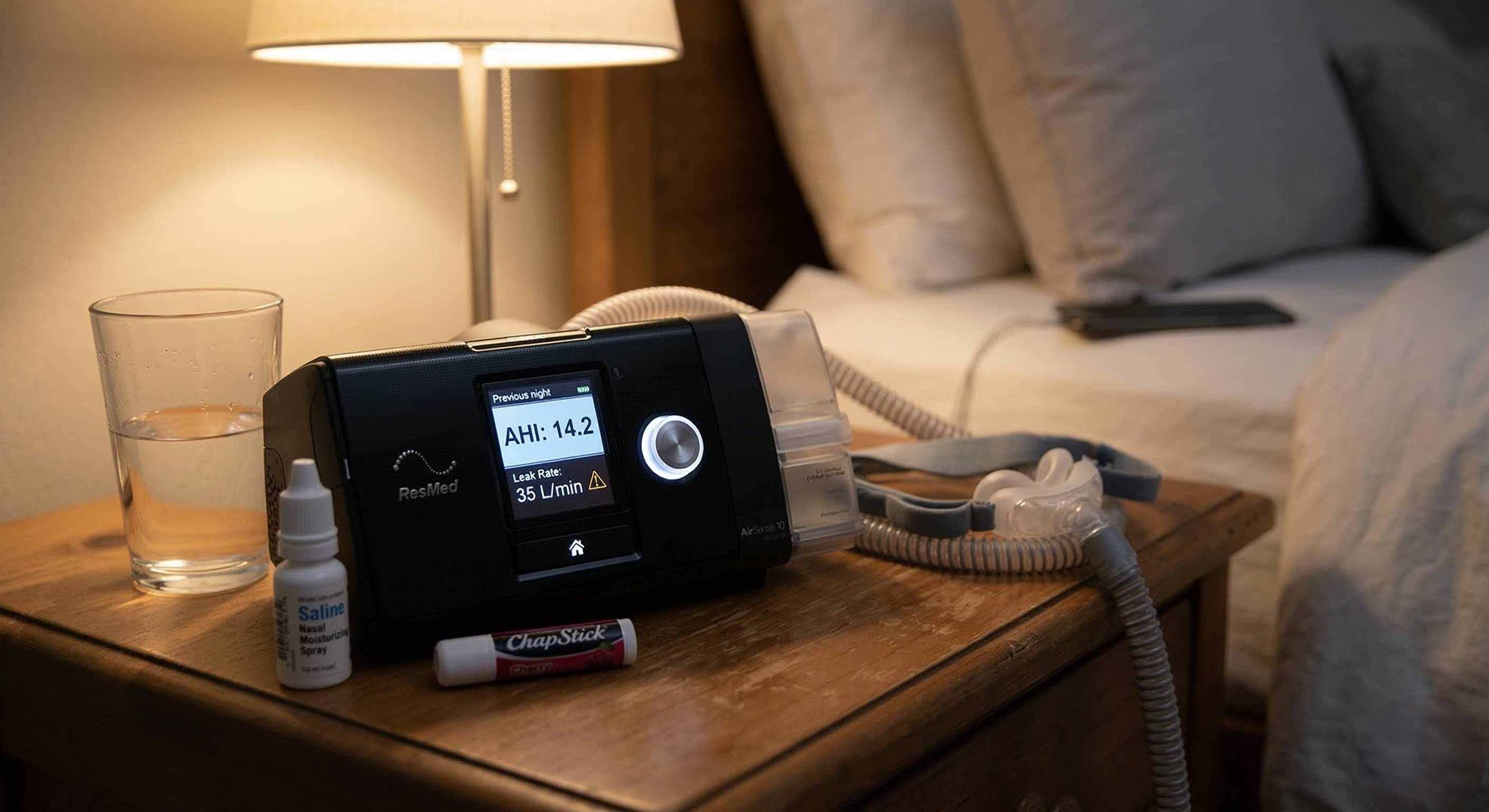
This is called mouth leak — and if you’ve ever checked your machine’s data and seen leak rates above 24 L/min, this is exactly what’s happening. The machine ramps pressure to compensate, which dries your throat even faster, which makes you unconsciously pull the mask off. By morning you’ve had maybe 3 hours of actual therapy.
50% of CPAP Users Quit Within a Year. This Is Why.
CPAP non-compliance is one of the most studied problems in sleep medicine. The numbers are brutal:
The pattern many people describe: mouth opens, pressure escapes, the machine ramps up, the throat dries out, and the mask comes off at 2am. You wake up with a dry mouth, and the night is over. Mouth tape is not a treatment for sleep apnea.
Chin straps, full-face masks, heated humidifiers — they’re all workarounds that treat symptoms. The root cause is that your lips aren’t sealed. Until you fix that, everything else is a band-aid.
“I went through three different masks in six months. Nasal pillows, nasal cradle, full face. My leak rate was always high and I’d wake up with the worst dry mouth of my life. I was ready to throw the whole machine in the bin.”
46 brands researched and scored, 7 recommended.
We scored every tape on adhesive safety, comfort, breathability, and value.
Your Jaw Relaxes. Your CPAP Becomes a Leaf Blower.
This isn’t a willpower problem. It’s physics — and your CPAP makes it worse.
The moment you enter deeper sleep, muscle tone drops across your entire body. Your jaw muscles — the ones holding your mouth shut all day — go slack. Within minutes of falling asleep, your mouth is open.
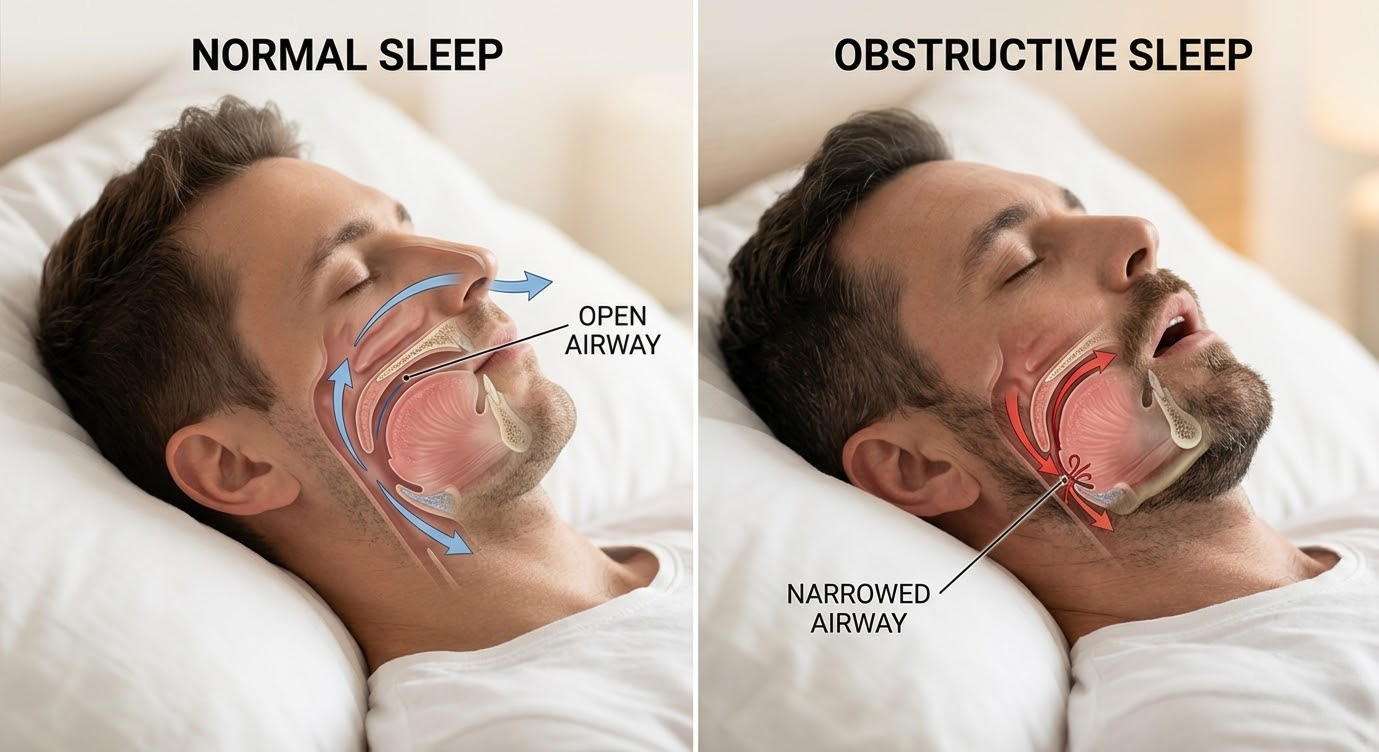
Now add CPAP. Positive pressure flowing through your nasal passages pushes down on your soft palate. If your lips aren’t sealed, that air has one exit: straight out your mouth. The higher your pressure setting, the harder it blows your mouth open. It’s the opposite of what you need.
The CPAP Mouth Leak Cycle
You fall asleep — jaw muscles relax, mouth begins to open
Air escapes — CPAP pressure vents straight through your open mouth
Machine ramps up — higher pressure means more drying, more discomfort
You wake up with a dry mouth and a sore throat
A chin strap holds the jaw. Mouth tape sits on the lips. Some people prefer one, some the other. Neither is a treatment for sleep apnea, and neither is a reason to change a prescribed machine.
A lip seal changes where CPAP air goes. That is not a treatment claim.
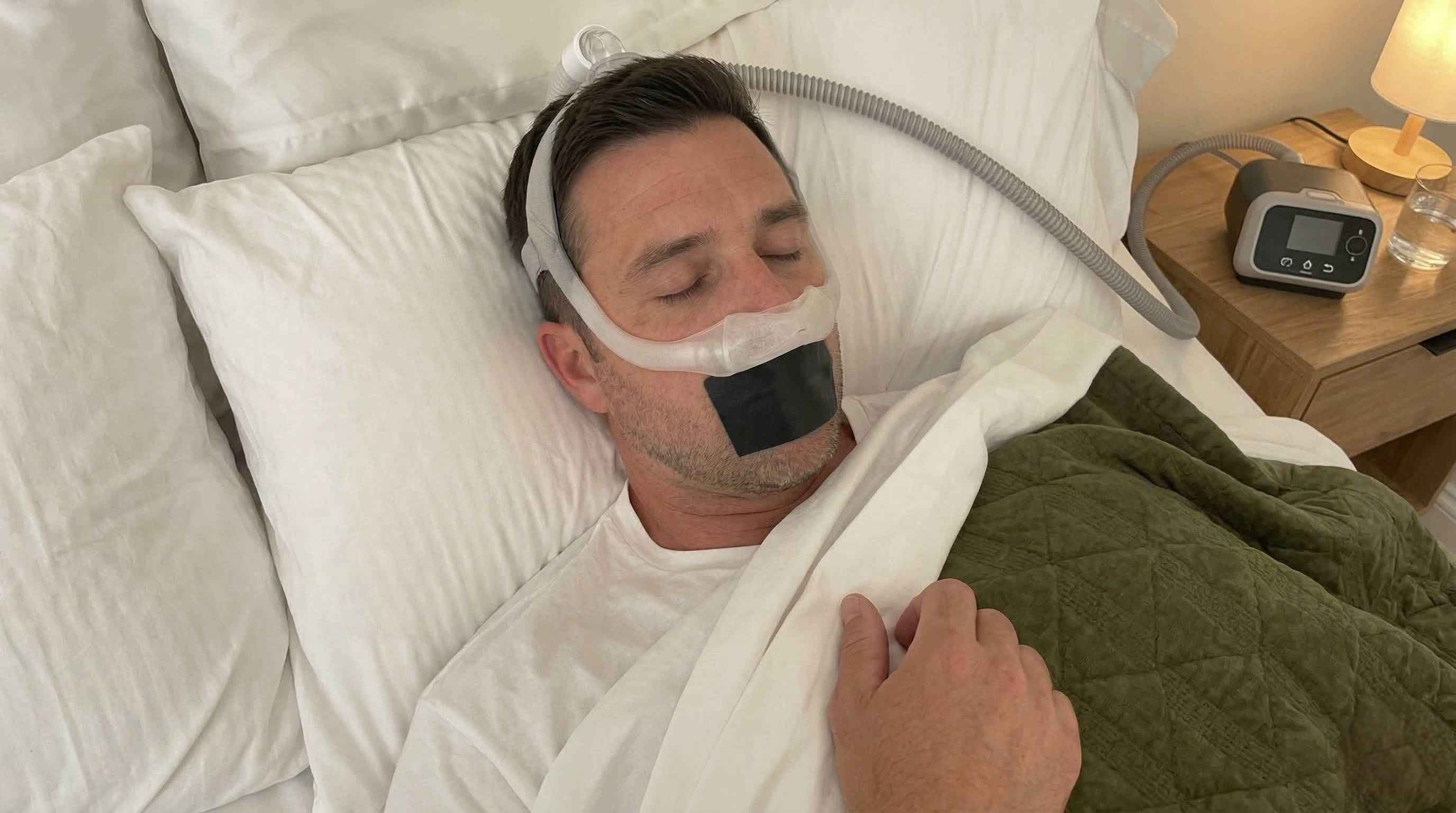
Some people try a porous tape over the lips so CPAP air stays on the nasal route. That is a comfort and leak question. It is not a fix for CPAP, and it is not a treatment for sleep apnea.
The biomechanics are sound — and the research backs it up:
A study in Chest found that mouth breathing during nasal CPAP was associated with higher leak and lower adherence.[2] That citation is not a claim that mouth tape treats sleep apnea or changes a pressure setting.

Published in Chest — one of the world’s leading respiratory medicine journals — researchers at Helsinki University Hospital studied CPAP patients and found that mouth breathing was the primary factor compromising treatment success.[2]
“Mouth breathing during nasal CPAP compromises its efficacy. Patients who breathed through their mouths had significantly higher residual apnea indices and lower adherence to therapy.”
Bachour & Maasilta, Chest, 2004
“My sleep doctor suggested I try mouth taping with my CPAP. I was sceptical, and I kept using the machine. One person’s experience is not a clinical result, and mouth tape is not a treatment for sleep apnea.”
Mild Sleep Apnea: What Research Has Measured — and What It Has Not
This is the part getting the most attention in sleep medicine right now.
CPAP is prescribed care for sleep apnea. Mouth tape is not a treatment and not a reason to skip a machine a clinician has prescribed.
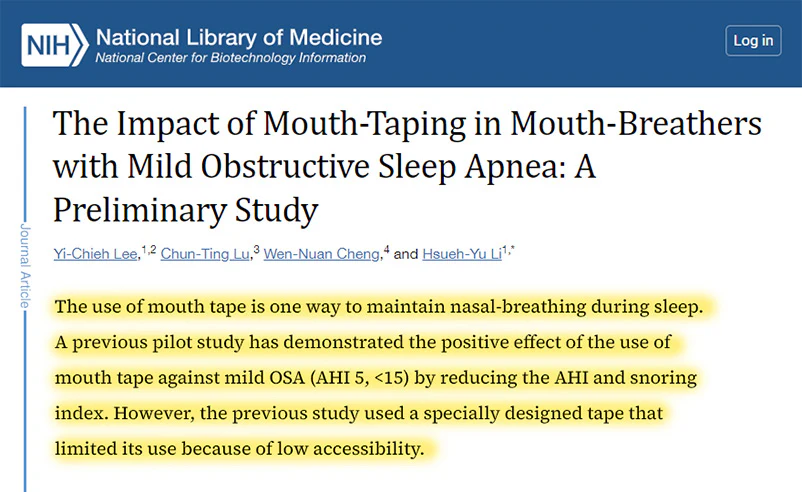
A cited study looked at mouth taping in people with mild obstructive sleep apnea.[3] Those results have limits. They are not proof that mouth tape treats sleep apnea, and they are not a reason to stop CPAP. Talk with a sleep clinician before changing therapy.
Mouth tape isn't a treatment for sleep apnea. If you snore heavily or gasp or choke in your sleep, get assessed first; don't tape with a blocked nose, and don't use on children without clinician guidance.
What a cited mild-OSA study measured — and what it did not establish.[3]
Study limits — a single citation is not a treatment claim for sleep apnea
Snoring — some people report less snoring. That is not a promise, and it is not a diagnosis
CPAP stays the standard — for moderate to severe OSA, do not stop a prescribed machine
Tape is a consumer product — small and portable, and still not a medical device for apnea
Mouth taping is not a replacement for CPAP in moderate to severe sleep apnea. If you’re considering reducing or stopping CPAP therapy, talk to your sleep specialist first. Mouth tape is not a treatment for mild sleep apnea either.
46 brands researched and scored, 7 recommended. Here is how the scores landed.
Scored on adhesive hold, skin safety, breathability, comfort, and CPAP compatibility.
Tried Mouth Tape Already? You Might Have Used the Wrong One.
This is where a lot of people stop. They try a cheap strip with CPAP and it falls off by 1am, irritates skin, or still lets air out at the edges. That experience is about that tape. It is not a treatment result.
CPAP creates demands on a mouth tape that normal use never does:
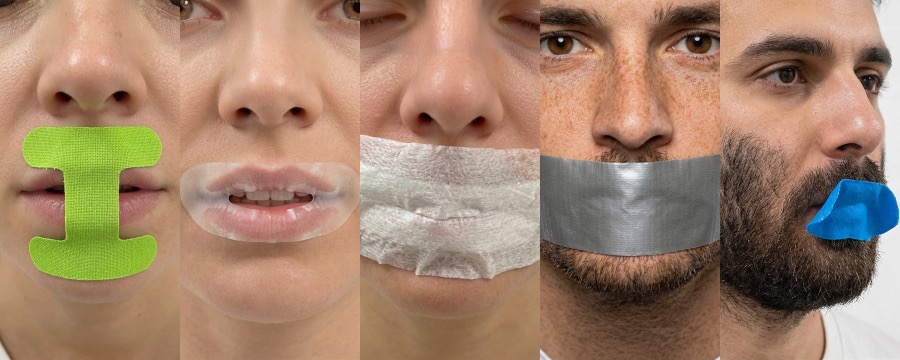
CPAP pushes air at 4–20 cm H₂O. Most tape adhesives peel at the corners, breaking the seal by midnight.
Under pressure, air finds every gap. You need full lip coverage to maintain a seal all night.
CPAP is nightly therapy. If a brand will not publish the adhesive, that is a gap in the file. Sleep Karma reports ISO 10993-1 certification (brand-published; not an Evident lab test).
What CPAP users should actually look for in a mouth tape.
The adhesive has to hold under positive pressure all night. The material has to be breathable for 3,000+ hours of annual use. And the ingredients have to be safe for long-term skin contact — something most brands won’t even disclose.
- Medical-grade adhesive that holds under CPAP pressure
- Sleep Karma reports ISO 10993-1 certification (brand-published; not an Evident lab test).
- Full-coverage shape for complete lip seal
- Breathable material (safety valve for emergency breathing)
- Clean removal (no residue that interferes with mask seal)
- Weak adhesives that peel under positive pressure
- Small strips or X-shapes that leak at the edges
- Undisclosed adhesive ingredients (nightly use = high exposure)
- Residue-leaving tapes (compromises CPAP mask adhesion)
- Non-breathable materials (no emergency airflow path)
“I tried three different mouth tapes with my CPAP. The cheap ones from Amazon peeled off within an hour. A fuller strip stayed on longer for me. One person’s night is not a leak-rate result, and mouth tape is not a treatment for sleep apnea.”
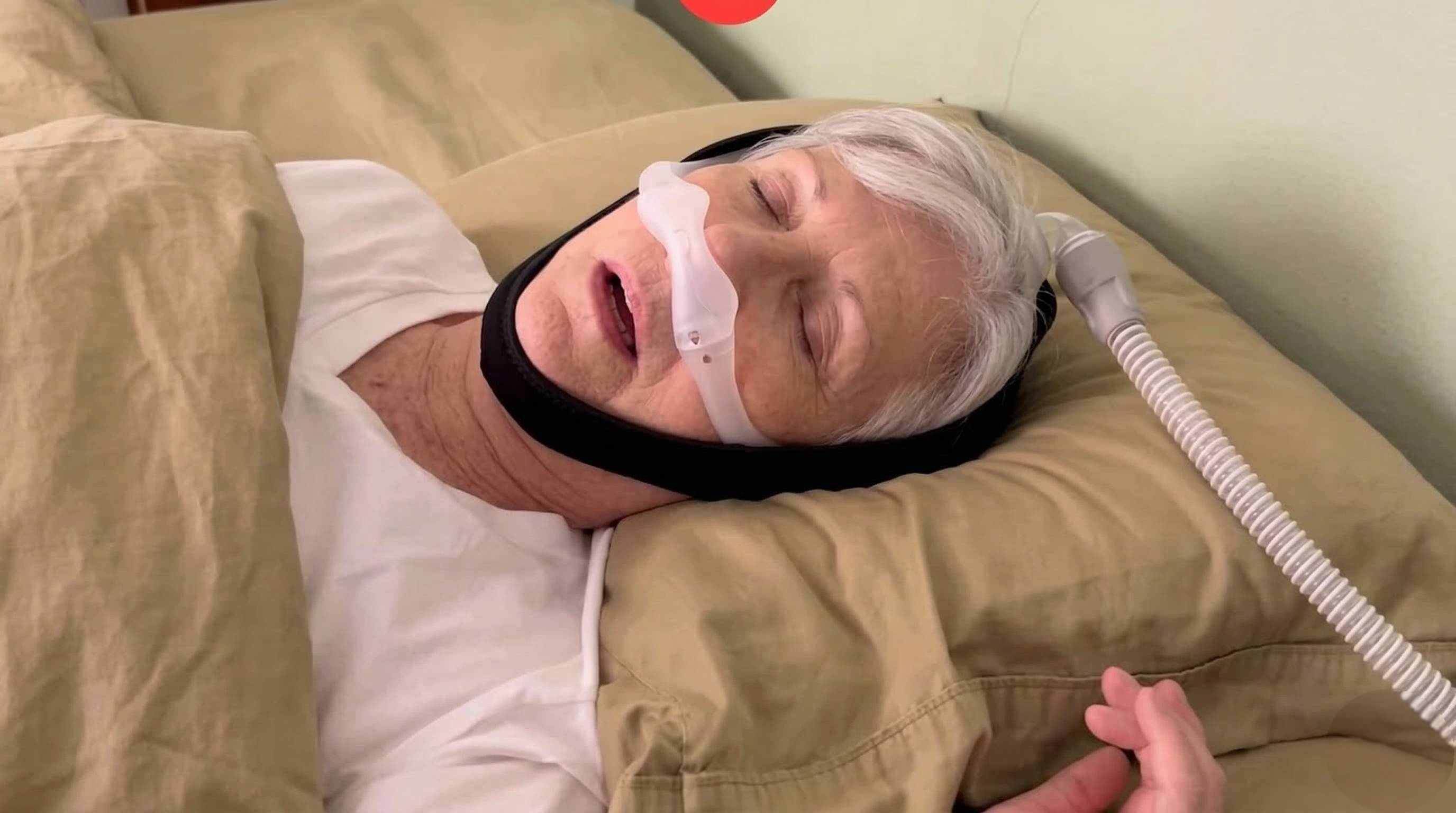
Using mouth tape with a CPAP chin strap
A chin strap holds the jaw. Mouth tape sits on the lips. Some CPAP users prefer a chin strap; others find mouth tape more comfortable. A few people wear both because the jaw and the lips are different gaps.
This is about comfort and whether air is leaving through the mouth. It is not a treatment claim, and it is not a reason to change a prescribed machine.
46 Brands Researched. 7 Recommended.
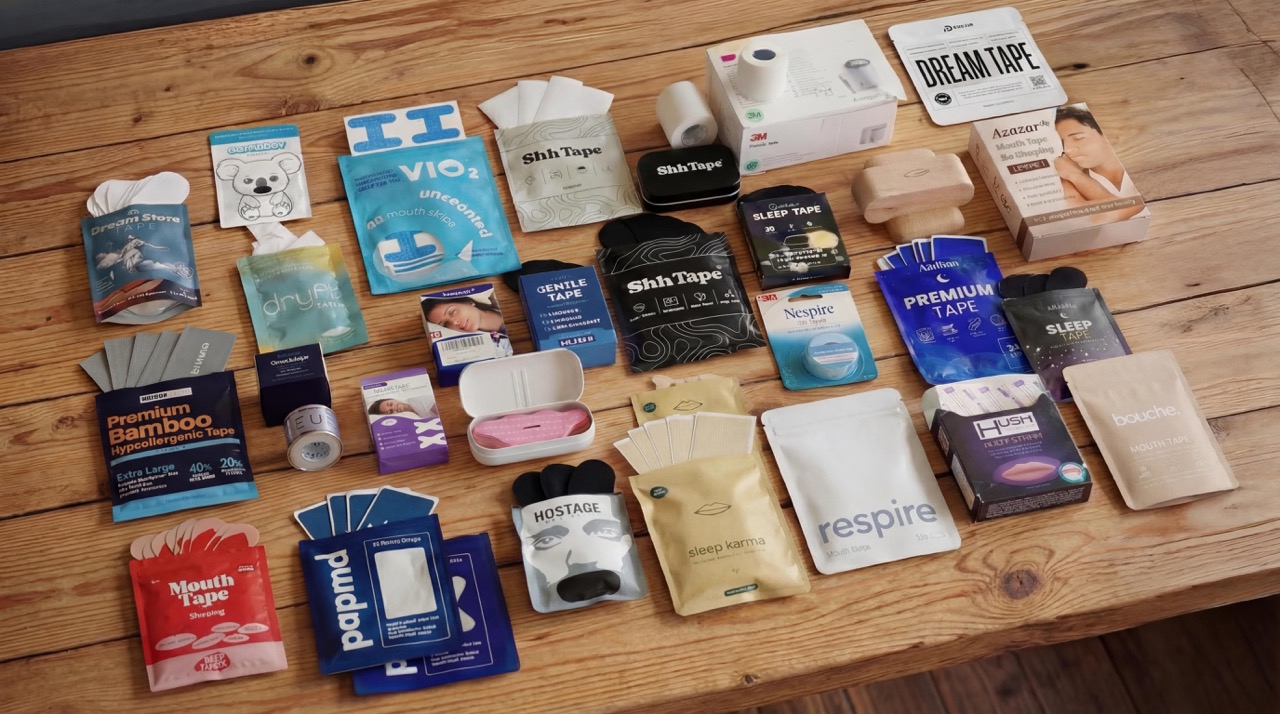
46 brands researched and scored, 7 recommended. We scored adhesive hold, skin, breathability, comfort, residue, and value. Most did not make the recommended set.
Weak adhesives that peeled under pressure by midnight. Tiny strips that leaked at the corners. Brands that wouldn’t disclose their adhesive ingredients. Tapes that left residue and wrecked your mask seal the next night. Only a handful held up — and even fewer were tapes we’d trust for nightly CPAP use.
Here’s how the top 3 scored:
| Brand | CPAP Hold | Skin Safety | Overall |
|---|---|---|---|
| 🥇 Sleep Karma | ★★★★★ | ★★★★★ | 8.9 |
| 🥈 VIO2 | ★★★★★ | ★★★★★ | 7.8 |
| 🥉 MyoTape | ★★★★★ | ★★★★☆ | 7.5 |
Full rankings for all 46 brands →
See how every tape scored — including under CPAP pressure.
Adhesive hold strength. Skin safety. Breathability. Comfort. Residue. All scored, all ranked.
Common Questions About Mouth Taping & CPAP
Frequently Asked Questions
Mouth tape is not a treatment, and it is not a reason to change a CPAP prescription on your own. Some tapes are porous. If your nose blocks, take the tape off. Talk with your sleep clinician before using tape with a machine.
Some people use tape with a nasal mask or nasal pillows. A full-face mask is a different setup. Mouth tape is not a reason to switch masks or change a prescription. Talk with your sleep clinician before changing how you use CPAP.
Some CPAP users prefer a chin strap; others find mouth tape more comfortable. Neither one is a treatment for sleep apnea.
Mouth tape is not a treatment for sleep apnea and it is not a substitute for CPAP. Do not stop CPAP because of anything on this page. Talk with your sleep clinician before changing therapy.
Poor-quality tapes can leave sticky residue on your skin, which can degrade the silicone seal of your CPAP mask over time. This is why clean-release adhesive is important for CPAP users. The best mouth tapes remove cleanly without residue, so your mask seal stays intact night after night.