
Moringa Benefits: What the Human Trials Show, at What Doses
Moringa leaves are a widely eaten food in parts of Africa and Asia and a popular powder and capsule in the U.S. The animal and lab results are plentiful. Here is what the human trials found, at what doses, and how that compares with a bottle.
Quick Summary
Human evidence is limited, the meta-analyses disagree, and trial doses are often higher than one capsule serving.
What is moringa?
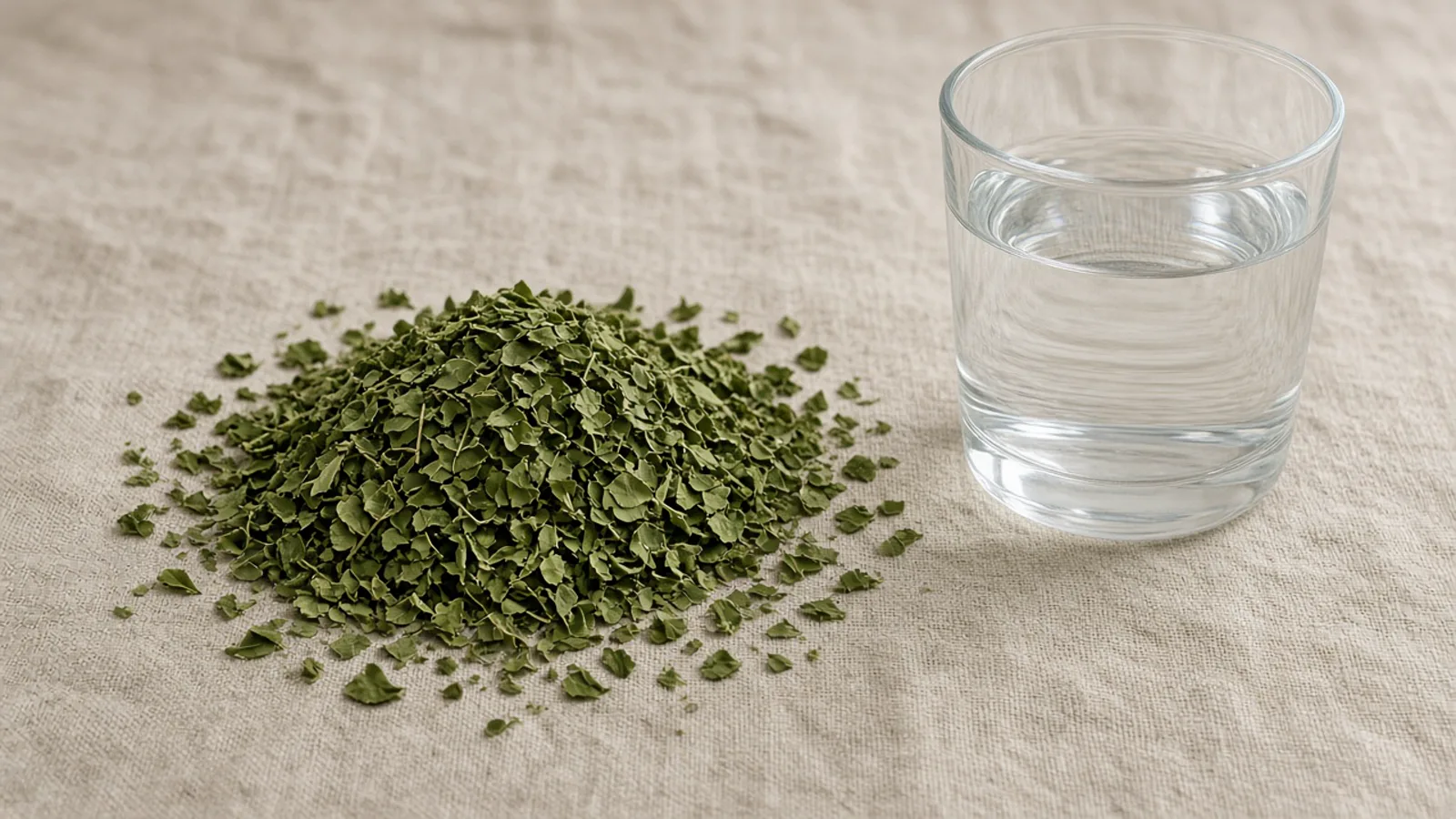
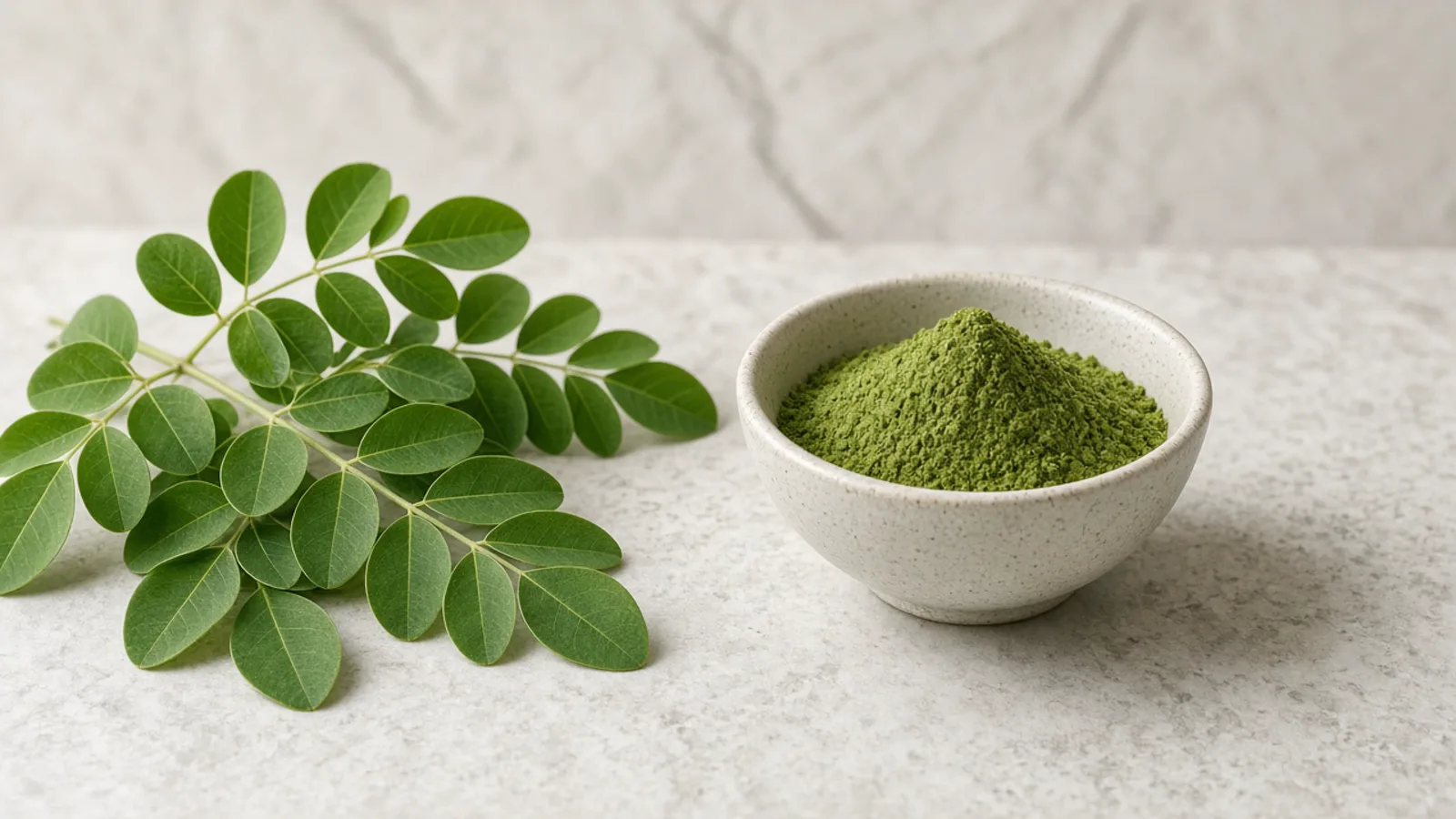
Moringa oleifera is a fast-growing tree native to South Asia. Its leaves and pods are eaten as food in many countries. Memorial Sloan Kettering says it is generally safe to eat the leaves and seeds, and to drink the powder mixed with liquid [7]. Supplement forms are leaf powder, capsules, leaf extracts, tea, and seed oil. The studies below used leaf powder in capsules or in a meal. We say which for each.
How strong is the evidence?
| Feature | What it is | What exists | Form |
|---|---|---|---|
| 1. Reviews of randomized trials | Three on metabolic outcomes, 2025–2026. | They disagree with each other. | Mostly leaf powder. Some extract. |
| 2. Individual randomized trials | Small and short. | The ones we opened were 12 weeks or a single meal. | Leaf powder capsules or powder in food. |
| 3. Case reports | Rare allergic and skin reactions. | Listed by Memorial Sloan Kettering. | Food or powder, depending on the case. |
| 4. Lab and animal | Very large. | Not used here for human claims. | Not a capsule. |
GRADE: Crișan 2025 rated certainty very low for all outcomes [1].
Three meta-analyses, three different answers
| Feature | Scope | What the abstract reported | The authors’ caveat |
|---|---|---|---|
| Crișan 2025, Nutrients | 9 RCTs, 649 adults | No significant effects on most outcomes. Diastolic blood pressure SMD −0.41, and that was not robust. | Certainty very low. “Current evidence does not support consistent cardiometabolic benefits.” |
| Samarin 2026, Food Science & Nutrition | 8 RCTs | Systolic −6.00 mmHg and diastolic −7.32 mmHg. No change in BMI or weight. Systolic differences in a 5–10 g/day subgroup. | The introduction says earlier evidence was insufficient to establish a causal link. We did not extract a GRADE rating. |
| Mokgalaboni 2026, Metabolism Open | 20 clinical studies in people with metabolic disorders | Fasting glucose SMD −0.70. HbA1c −0.62 percentage points. Systolic −7.50 and diastolic −6.82 mmHg. | “Preliminary and hypothesis-generating.” Heterogeneity and study quality were limitations. |
They pooled different sets of trials (9 vs 8 vs 20), different populations, and different forms. We weight the one with a formal certainty rating, Crișan, most heavily, and treat the other two as hypothesis-generating, which is what one of them says. All three are about measured values in trials. They are not a claim about what moringa does for you.
The individual human trials we opened
These are small. “Prediabetes” and “diabetes” are the trial populations. This page is not advice on those conditions.
| Feature | Who | Form and dose | What was measured |
|---|---|---|---|
| Gómez-Martínez 2021, 12 weeks | 65 adults with prediabetes (31 moringa, 34 placebo) | Leaf-powder capsules, 2,400 mg/day | Fasting glucose and HbA1c moved in opposite directions: down in the moringa group, up with placebo. No group difference in gut microbiota, liver or kidney markers, or appetite hormones. |
| Díaz-Prieto 2022, same trial | Same 65 adults | Same 2,400 mg/day | No differences in lipids, inflammation markers, or blood pressure on the change scores. |
| Leone 2018, one meal | 17 people with diabetes and 10 without, in Saharawi refugee camps | 20 g leaf powder in a meal | Lower after-meal glucose increments in the diabetes group only. The authors say the 20 g meal tasted poor. |
Moringa for men and for women
Men. A PubMed search on October 28, 2026 for moringa, testosterone, and randomized trials returned one paper. It was a study in diet-induced obese rats, not people. We are not describing an effect on testosterone, sperm, or erectile function.
Women. A search for moringa and menopause returned a paper about progesterone binding to seed biomass in a lab, not a trial in women. The human research we opened that is specific to women is about pregnancy and breastfeeding, below.
Breastfeeding and pregnancy
Memorial Sloan Kettering’s professional monograph says pregnant and breastfeeding women should avoid moringa. The patient section says to talk with a healthcare provider, and that moringa may not be safe in pregnancy or breastfeeding [7].
We could not open NIH LactMed (NBK501899) in a browser, so this page does not quote it.
A 2026 review of herbal galactagogues in mothers of preterm babies included 10 randomized trials, each of a different herb or mixture, and rated the evidence low certainty [we did not use that review to claim a moringa effect]. We are not making a claim about breast milk. Talk to a clinician before using moringa while pregnant or breastfeeding.
The dose reality check
Trial doses are often larger than one label serving. Prices checked October 28, 2026.
Gómez-Martínez trial dose: 2,400 mg a day of leaf powder.
Nature’s Way Moringa: $19.99 for 120 capsules. A serving is 2 capsules and the page states 800 mg of moringa leaf. That is 60 servings, about $0.33 a serving. Matching 2,400 mg a day would be 6 capsules, about $1.00 a day. That is our arithmetic, not a dose we are suggesting.
Nature’s Truth Moringa Oleifera: $18.99. The product text we read calls the serving a proprietary blend and says two capsules daily. It does not state milligrams or a capsule count, so no per-serving price is shown.
A label may say “equivalent to” a larger amount of fresh leaf. That is the brand’s calculation, not a measured dose. Nothing here says that taking a trial dose is safe or useful.
Safety, interactions, and quality
Food versus concentrates. Memorial Sloan Kettering says the leaf and seed are generally safe to eat. It also says supplements are stronger than the herb used in cooking [7].
Medicine interactions are preclinical. The professional monograph lists lab signals, including CYP3A4, and says clinical relevance has yet to be determined. If you take medication, ask your pharmacist.
Rare reactions. The same monograph lists case reports of Stevens-Johnson syndrome, skin toxicity, and anaphylaxis.
Animal toxicity at a high dose. It notes genotoxicity in mice at 3,000 mg/kg.
Quality. Ask for a certificate of analysis for the lot, covering microbes, pesticides, and metals. We did not re-verify a German consumer-testing report, so it is not cited and no brand is named.
Who should skip it or ask first
Ask first
- ✓Pregnant or breastfeeding.
- ✓Taking prescription medicine.
- ✓A history of allergic or skin reactions to herbal products.
- ✓Planning surgery.
A reason to skip it
- ×Buying powders for children.
How to read a moringa label
- Milligrams of leaf per serving, not a blend total.
- Servings per container and price per serving.
- Form: leaf powder, extract, or blend.
- A certificate of analysis for the lot.
- Stay at or below the directions.
- Read “equivalent to X grams of fresh leaf” as marketing until a lab says otherwise.
Questions
Moringa is widely studied in animals and the lab. Human trials are small. A 2025 meta-analysis rated the certainty of cardiometabolic results very low and said current evidence does not support consistent cardiometabolic benefits. Two 2026 meta-analyses reported blood-pressure differences. One of them calls its own results preliminary and hypothesis-generating.
The meta-analyses disagree. Crișan 2025 found no consistent effects and rated certainty very low. Samarin 2026 reported lower systolic and diastolic blood pressure and no change in weight. Mokgalaboni 2026 reported lower fasting glucose and blood pressure and called the results preliminary. The trials were small and short. This is not advice for blood sugar or blood pressure.
An 8-trial meta-analysis found no change in body weight or BMI (Samarin 2026). We are not making a weight claim.
A PubMed search for moringa, testosterone, and randomized trials returned a rat study, not a human trial. We are not claiming an effect on testosterone, sperm, or erectile function.
A PubMed search for moringa and menopause returned a chemistry paper about progesterone sticking to seed biomass, not a human trial. Breast-milk research exists but is low-certainty, and Memorial Sloan Kettering lists pregnancy and breastfeeding as a reason to avoid moringa.
Memorial Sloan Kettering says it is generally safe to eat the leaves and seeds, and to drink the powder mixed with liquid. Concentrated supplements are a different exposure. The professional monograph lists rare case reports, including a severe skin reaction and anaphylaxis.
A PubMed search for moringa tea and randomized trials returned broader herbal lactation reviews, not a trial of moringa tea. We are not describing an effect of the tea.
Doses in the trials we read ranged widely: 2,400 mg a day of leaf powder in capsules for 12 weeks, 20 g in a single meal, and 5–10 g a day in one blood-pressure subgroup. This is not a recommendation. Follow the label.
Our read
Moringa is a traditional food leaf with a thin human-trial record. Meta-analyses disagree, the certainty rating on the GRADE review is very low, and the doses in studies are higher than one capsule serving. If you like it as a food, that is a reasonable reason to use it. As a supplement, buy only with a certificate of analysis, and skip it or ask first if you are pregnant, breastfeeding, or on medicine.
How we checked
On October 28, 2026 we opened the Memorial Sloan Kettering moringa monograph in a browser and read the PubMed abstracts cited above. The “very low” certainty line and the sentence “does not support consistent cardiometabolic benefits” are from the Crișan abstract.
Nature’s Way’s shop record listed 120 capsules at $19.99 and 800 mg of leaf per 2-capsule serving. Nature’s Truth’s record listed $18.99 and a proprietary blend, without milligrams or a capsule count.
LactMed did not load. A German contamination report and a uterine-contraction line from secondary sites were not re-opened, so they are omitted.
Sources
- 1.Crișan et al. Nutrients. 2025. PMID 41305552. GRADE meta-analysis.
- 2.Samarin et al. Food Science & Nutrition. 2026. PMID 42254443.
- 3.Mokgalaboni et al. Metabolism Open. 2026. PMID 41816507.
- 4.Gómez-Martínez et al. Nutrients. 2021. PMID 35010932.
- 5.Díaz-Prieto et al. Nutrients. 2022. PMID 35565903. Same trial, secondary analysis.
- 6.Leone et al. Nutrients. 2018. PMID 30322091.
- 7.Memorial Sloan Kettering. About Herbs: Moringa oleifera. Read in a browser October 28, 2026.
- 8.Nature’s Way. Moringa, 120 capsules. Shop record read October 28, 2026.
Keep reading
These statements have not been evaluated by the Food and Drug Administration. This product is not intended to diagnose, treat, cure, or prevent any disease. Evident does not sell any of these products and uses no affiliate links. Prices checked October 28, 2026.
Related reading
Most read in Herbal
Explore