
Beef Tallow for Skin
Tallow is having a moment on social media. The research is thin, and some of its main fats can clog pores.
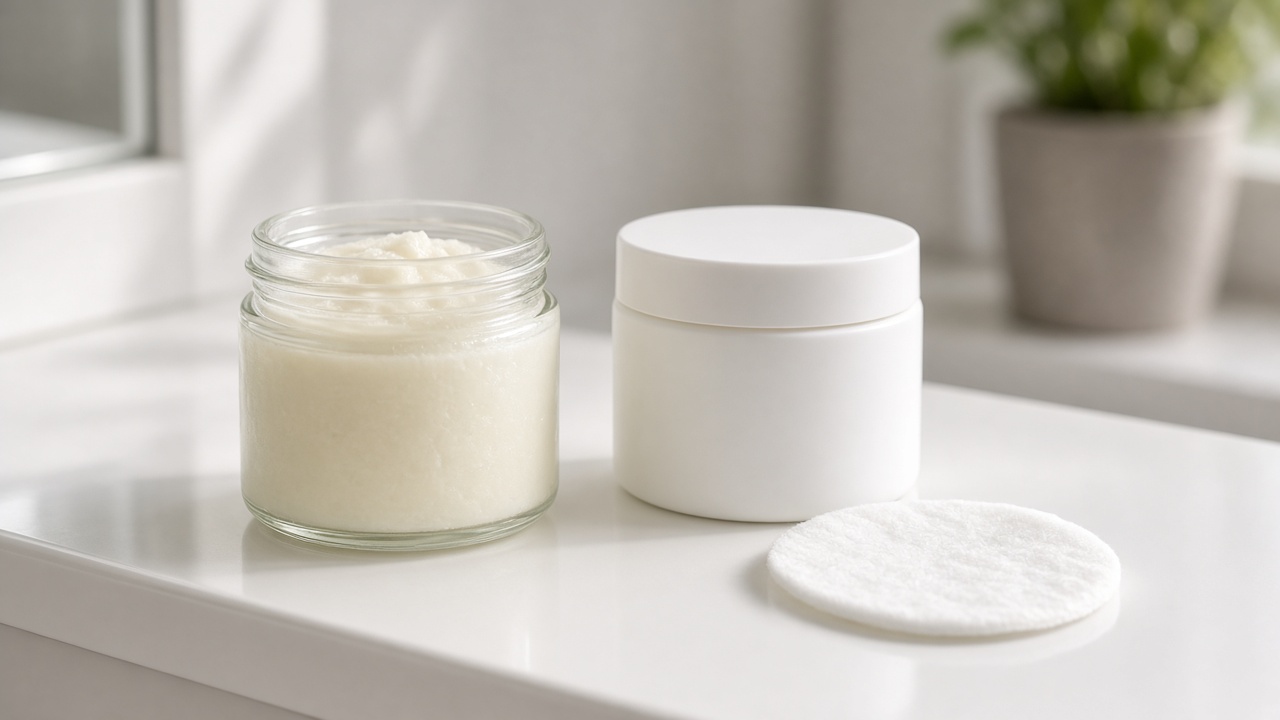
Quick Summary
Tallow can moisturize dry skin because it is an occlusive fat. The viral claims for acne, eczema, and wrinkles do not have human trials behind them, and the fat mix can clog pores.
What's in beef tallow
Beef tallow is rendered beef fat. On skin it is an occlusive: it sits on the surface and slows water loss, which is why it can feel moisturizing. The fatty-acid mix below is from USDA FoodData Central, beef tallow, FDC 171400. Products differ by the animal's diet and by processing.
Fatty acids per 100 g of beef tallow
| Feature | Amount | What it means for skin |
|---|---|---|
| Oleic (18:1) | 36.0 g | Softens skin. In high amounts it may weaken the barrier. The olive-oil study below is an analogy, not a tallow trial. |
| Palmitic (16:0) | 24.9 g | Saturated and occlusive. Flagged as a clogging fat in the 2025 social-media review. |
| Stearic (18:0) | 18.9 g | Saturated and occlusive. |
| Palmitoleic (16:1) | 4.2 g | A minor share. |
| Myristic (14:0) | 3.7 g | A minor share. Often flagged as comedogenic. |
| Linoleic (18:2) | 3.1 g | The barrier-supporting fat, and it is low in tallow. |
| Alpha-linolenic (18:3) | 0.6 g | A minor share. |
Tallow also contains trace vitamins A, D, E, and K. How much skin absorbs from a balm is not known.
Is beef tallow good for your skin?
It can work as a basic moisturizer, especially on dry skin, hands, and elbows. That is what occlusive fats do. Tufts dermatology faculty describe tallow as moisturizing and highly comedogenic (Tufts).
What is missing is proof of the bigger claims. Russell et al. (2024) screened 147 studies and included 19. None were human trials of tallow as a skincare product, and the findings on side effects were inconsistent (Cureus). Almatroud et al. (2025) analyzed social-media posts about tallow skincare. Claims about acne, eczema, and psoriasis mostly had no evidence behind them, and most posts came from accounts selling tallow.
On wrinkles: we found no evidence that tallow reduces them. For aging skin, sunscreen and retinoids have far stronger evidence. See retinoids explained.
Beef tallow for your face: the risks
- Clogged pores and breakouts. Tallow is mostly oleic and palmitic acid. Dermatologists and the 2025 review flag both as possible acne triggers. In an acne routine, the moisturizer step should be non-comedogenic. See the skincare routine for acne.
- Barrier effects of oleic acid, as an analogy only. In a 4-week study of 19 adults, olive oil, which is high in oleic acid, weakened the skin barrier and caused mild redness. Sunflower oil, which is high in linoleic acid, did not. That study used olive oil, not tallow.
- Irritation and allergy. Cleveland Clinic notes possible irritation, including rosacea flares, and allergic reactions.
- Not regulated as a skin treatment. Small-batch and homemade tallow can vary in purity and in how it is stored.
Who should skip tallow on the face
- Acne-prone or oily skin.
- Rosacea or very sensitive skin. Patch-test first if you still want to try it.
- Eczema: talk to a dermatologist. Fragrance-free ceramide moisturizers and petrolatum have more evidence.
- Anyone avoiding animal products.
If you want to try it
Patch-test on the inner arm for a few days. Use a small amount on dry areas first, not the whole face. Choose a short ingredient list and no added fragrance. Stop if you break out or get red. This page does not name a brand.
The moisturizer category is at moisturizers. For breakouts, start with a skincare routine for acne.
How we checked
Russell et al., Cureus, 2024. PMID 38910727.
Almatroud et al., Journal of Cosmetic Dermatology, Dec 2025. PMID 41312576.
USDA FoodData Central, fat, beef tallow, FDC 171400.
Cleveland Clinic Health Essentials, beef tallow for skin.
Tufts University School of Medicine, What's the deal with beef tallow? (Moustafa).
National Geographic, quoting dermatologist Rajani Katta, MD.
Danby et al., Pediatric Dermatology, 2013. Olive oil versus sunflower oil. PMID 22995032. Cited as an oleic-acid analogy, not as a tallow study.
Frequently Asked Questions
It can moisturize dry skin. No human trials support claims that it treats acne, eczema, or wrinkles.
It can. It is high in oleic and palmitic acid, and dermatologists describe it as comedogenic.
There is no trial evidence. A 2025 analysis found most social-media eczema claims were unsupported. Ask a dermatologist.
If your skin is dry and does not break out, maybe. Patch-test first. Acne-prone skin should avoid it.
There is no evidence it is. Moisturizers with ceramides, glycerin, or petrolatum have far more research behind them.
Related reading
Most read in Skin
Explore
This is an evidence review of a cosmetic ingredient. It is not medical advice, and it is not a claim that tallow treats acne, eczema, or wrinkles. No product picks and no affiliate links.