
Sleepmaxxing, Explained
A clear-eyed map of the trend: circadian basics first, gadgets second, and no medical claims for viral hacks.
💡Key takeaways
- Sleepmaxxing is internet slang for stacking sleep habits. It is not a diagnosis or a protocol.
- The habits most sleep advice repeats are still the plain ones: a stable schedule, a dark and quiet room, less alcohol, and a clinician if you snore, gasp, or fight daytime sleepiness. This page does not cite a trial for a caffeine cutoff or a room temperature.
- Mouth tape has a small, mixed research base. A 2025 review of 10 studies found some improvement in two of them, no difference in others, and a risk of serious harm if the nose is blocked. PLoS One, Cleveland Clinic, and Harvard Health all urge caution.
- Evident’s observational pilot used Sleep Karma tape with 29 adults and 81 nightly logs. Sleep quality was 7.1 with tape and 5.7 without. Dry-mouth logs were 12% with tape and 59% without. Tracker scores were 81.7 vs 77.9. It was not randomized or blinded. Evident’s parent company owns Sleep Karma. Full results.
What sleepmaxxing means
On social media, sleepmaxxing usually means treating sleep like a system you can stack: a fixed bedtime, morning light, nasal-breathing experiments, supplements, wearables, and recovery gadgets. The word is not a medical term. A creator checklist is marketing unless the claim points at a study you can read.
Nothing on this page is a prescription. Sleep apnea and other sleep disorders need a clinician. Mouth tape is not a treatment for them.
Habits people stack first
These are the themes sleep advice repeats. We are not prescribing them, and we did not run a trial of a bedtime, a room temperature, or a caffeine cutoff. Where a source we read does speak, it is named.
- Keep a stable sleep and wake window, including weekends when you can.
- Make the room dark and quiet enough to stay asleep.
- Go easy on alcohol. Mayo Clinic says alcohol and sedatives can relax the throat and worsen obstructive sleep apnea, and that more than a moderate amount of alcohol works against prevention.
- If you snore loudly, gasp, stop breathing in your sleep, or fight daytime sleepiness, get evaluated. Stacking hacks on an untreated disorder wastes time. Mayo Clinic lists those symptoms for sleep apnea. A doctor has to decide whether that is what you have.
Caffeine timing and a cooler room show up constantly in sleepmaxxing threads. We do not have a source on this page for a specific cutoff or a degrees number, so we are not stating one.
Tools people add next
Wearables
Our take, not a study result: a tracker is useful as a diary of patterns. A single nightly score is not a diagnosis.
Nasal strips and congestion
A stuffy nose is a common reason people mouth-breathe. We have not graded nasal strips on this page. The comparison lives at mouth tape vs nasal strips.
Mouth tape
Tape only forces nasal breathing if the nose is already open. Rhee and colleagues, PLoS One, May 21, 2025, reviewed 10 studies. Two reported a statistically significant improvement on apnea measures. Others found no difference. The results section warns about asphyxiation when the nose is blocked, and many of the included studies left out people with nasal obstruction. The authors’ conclusion is that taping without knowing whether you can nose-breathe carries a potentially serious risk, and that more research is needed before a clinical benefit is clear.
Cleveland Clinic (July 25, 2025) says there is not enough evidence that mouth tape stops snoring, that it is not part of their practice for treating a sleep disorder, and that people with a blocked or congested nose should not use it. Talk to a doctor first. Harvard Health (July 1, 2023) says taping during sleep can hamper breathing, disrupt sleep, or irritate skin, and that oxygen can drop. Harvard wrote that it had seen no research supporting the practice. The 2025 review later found those 10 studies, and they are mixed. Both pages still land on caution and a doctor visit if nasal breathing is hard.
Shopping is on best mouth tape. Safety limits are on is mouth tape safe. Dry mouth, which is a separate question, is on dry mouth at night.
Supplements and cold plunges
Magnesium, melatonin, and cold plunges show up in sleepmaxxing threads. We have not reviewed them, so this page does not give doses, temperatures, or outcomes. A product we have not reviewed stays unreviewed.
Claims to ignore until better data
It does not. Sleep apnea needs a doctor. Mouth tape is not a treatment and it is not a substitute for an evaluation.
Those outcomes are not in the sources we read for this page. We are not repeating them as effects.
A marketing label is not a safety study. Cleveland Clinic still says to talk to a doctor before taping, and the 2025 review flags harm when the nose is blocked.
Evident’s data point
We ran a small observational pilot: 29 adults, 81 nightly logs, alternating tape and no-tape nights with Sleep Karma tape. Self-rated sleep quality was 7.1 with tape and 5.7 without. Dry mouth was reported on 12% of taped logs and 59% of untaped logs. Tracker scores were 81.7 with tape and 77.9 without, a smaller move than the self-ratings. The study was not randomized or blinded, and it was not a clinical trial. Evident’s parent company owns Sleep Karma.
Use the pilot as a transparent real-world sample. It is not proof that sleepmaxxing works, and it is not proof that mouth tape treats a sleep disorder.
A sane checklist
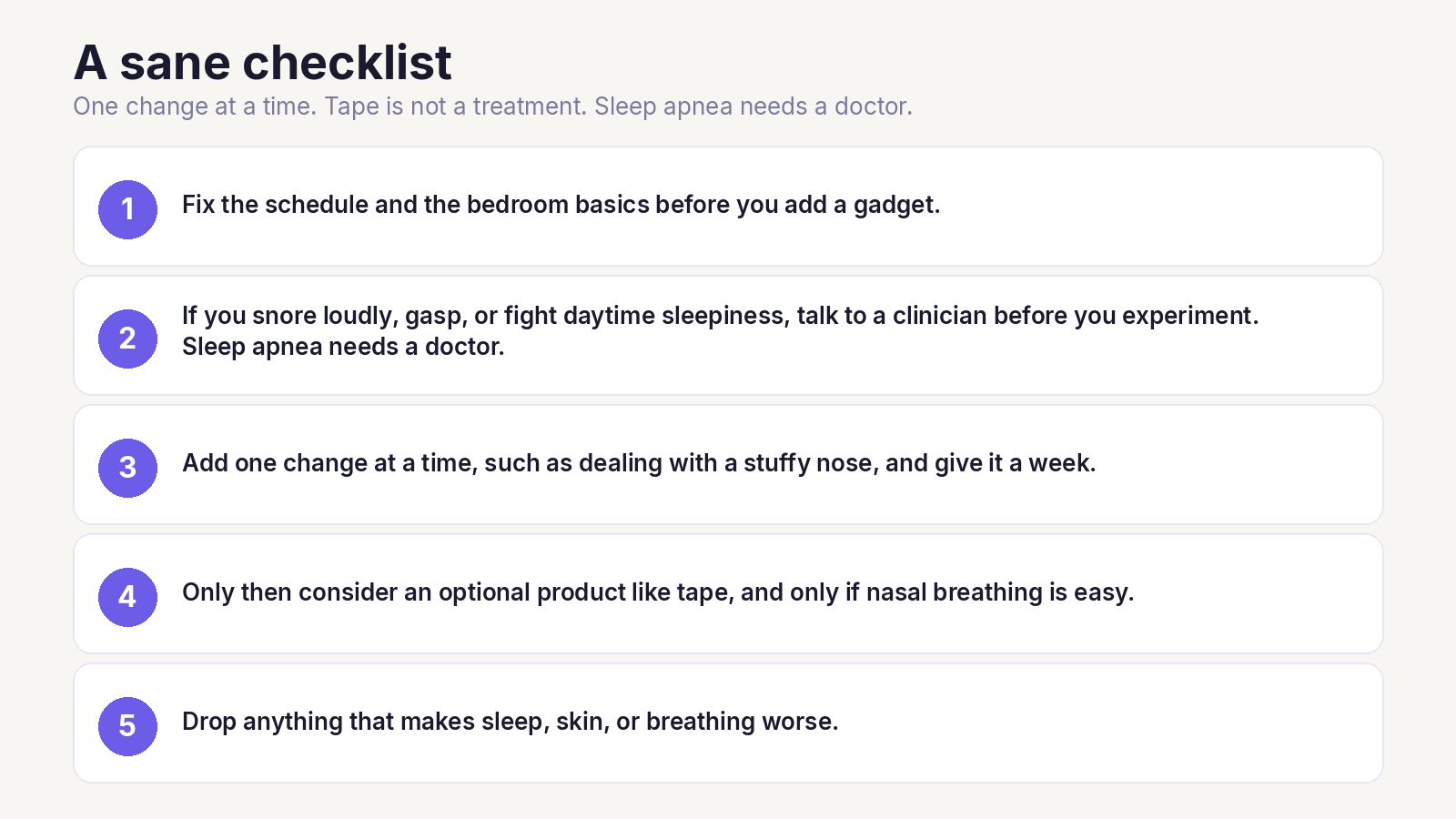
Fix the schedule and the bedroom basics before you add a gadget.
If you snore loudly, gasp, or fight daytime sleepiness, talk to a clinician before you experiment. Sleep apnea needs a doctor.
Add one change at a time, such as dealing with a stuffy nose, and give it a week.
Only then consider an optional product like tape, and only if nasal breathing is easy.
Drop anything that makes sleep, skin, or breathing worse.
How we checked
On October 19, 2026, we read the Rhee et al. systematic review of mouth taping in PLoS One, the Cleveland Clinic and Harvard Health mouth-taping pages, and Mayo Clinic’s sleep apnea symptoms page. The pilot numbers are the ones already published on our sleep-study results page. Habits with no source on this page are labeled as repeated advice, not as findings.
How Evident scores products is a separate method. It does not apply to the papers cited here.
Read the limits with the numbers
29 adults, 81 nightly logs, Sleep Karma tape. Not randomized or blinded. Evident’s parent company owns Sleep Karma.
Questions people ask
Informal slang for stacking sleep habits and products to optimize sleep. It is not a medical diagnosis or a treatment protocol.
A steady schedule and a dark, quiet room are the habits most sleep advice repeats. This page does not cite a trial that proves a specific caffeine cutoff, room temperature, or weekend schedule. Viral extras are uneven. Mouth tape has a small, mixed research base and a real risk if you cannot breathe through your nose.
Often, on social media. A 2025 systematic review of 10 studies found mixed results and warned about harm when people tape without knowing whether the nose is open. Cleveland Clinic and Harvard Health also urge caution.
Only if breathing through your nose is easy, and only with the understanding that tape is not a treatment. Read the safety page before you try it. Sleep apnea needs a doctor.
On the mouth tape sleep study page: 29 adults, 81 nightly logs, Sleep Karma tape, not randomized or blinded. Evident’s parent company owns Sleep Karma.
Sources
Checked October 19, 2026.