Fruiting Body vs. Mycelium-on-Grain
Most 'mushroom' coffee uses the cheaper, less potent form
If the label doesn't specify 'fruiting body,' it's almost certainly mycelium grown on grain. The grain becomes part of the product and can make up the majority of the powder.
There is one quality question in the functional mushroom industry that matters more than any other, and most consumers have never heard of it. It is the question of whether the "mushroom" in your mushroom coffee is actually mushroom — or whether it is mostly rice flour with mushroom roots growing through it.
This is not a fringe debate. In 2017, the United States Pharmacopeia tested 19 reishi supplements sold in the U.S. and found that only 5 of them — 26% — were verified as genuine reishi mushroom. The rest had "a starch-like polysaccharide profile inconsistent with reishi mushroom." The same problem exists in lion's mane, cordyceps, turkey tail, and chaga products. And it is the reason a single number on a Certificate of Analysis — the beta-glucan percentage — can tell you whether you are getting medicine or rice flour.
Fruiting body vs. mycelium: what is the difference?
When you picture a mushroom, you are picturing the fruiting body. Cap, stem, gills. The visible part that grows above the substrate. This is the part that traditional medicine has used for thousands of years. It is rich in beta-glucans (the primary bioactive compound in functional mushrooms) and species-specific secondary metabolites like the triterpenes in reishi, the erinacines and hericenones in lion's mane, and the cordycepin in cordyceps.
Mycelium is something else. Mycelium is the root-like network of filaments that grows under the substrate, branching through whatever the mushroom is growing on. In a forest, mycelium grows through soil and decaying wood. In a supplement factory, mycelium is grown on sterilized grain — usually brown rice or oats — in a process called solid-state fermentation. After a few weeks, the mycelium has colonized the grain and the whole block (mycelium plus undigested grain) is dried and ground into powder. This is what you buy when you buy a "mycelium-on-grain" product, often abbreviated MOG.
Here is the problem: mycelium cannot be fully separated from the grain it grows on. They are physically intertwined at the cellular level. So a mycelium-on-grain product is not pure mycelium — it is a mixture of mycelium and rice flour. Independent testing has shown that some MOG products contain 50-70% grain starch by weight. You are paying mushroom supplement prices for what is largely rice flour.
The beta-glucan gap
Beta-glucans are the primary bioactive compound in functional mushrooms. They are polysaccharides found in fungal cell walls, and they are responsible for most of the immune-modulating, anti-inflammatory, and potential neuroprotective effects studied in clinical trials. Beta-glucan content is the single most important quality metric for a mushroom product.
The Megazyme K-YBGL test, which is the industry standard for measuring beta-glucan content, separates beta-glucans (from mushroom cell walls) from alpha-glucans (which is starch — overwhelmingly from grain substrate). Here is what the test typically returns for fruiting body extracts versus mycelium-on-grain:
- Premium fruiting body extracts: 25-35% beta-glucan, less than 5% alpha-glucan (starch).
- Standard fruiting body extracts: 15-25% beta-glucan, less than 10% alpha-glucan.
- High-quality mycelium with well-digested substrate: 10-15% beta-glucan, 10-20% alpha-glucan.
- Typical mycelium-on-grain: 1-7% beta-glucan, 35-40% alpha-glucan.
Look at that bottom line again. A typical mycelium-on-grain product tests at 1-7% beta-glucan and 35-40% starch. By weight, the product is at least five times more rice flour than active mushroom compound. A premium fruiting body extract, by contrast, can deliver 5-30 times more beta-glucan per serving than a MOG product at the same label weight.
This is what the 2017 USP reishi study captured. The study used HPTLC, colorimetric methods, GC-MS, and high-performance size-exclusion chromatography to analyze 19 reishi supplements. Only 5 of 19 were verified as actual reishi. The rest had the polysaccharide signature of grain, not mushroom. Three of the five passing samples were Nammex extracts — the same Nammex that publishes per-batch beta-glucan COAs and supplies brands like Real Mushrooms. The other 14 were pulled from the same supplement aisles where most mushroom coffees sit today.
Which mushroom coffee brands use which?
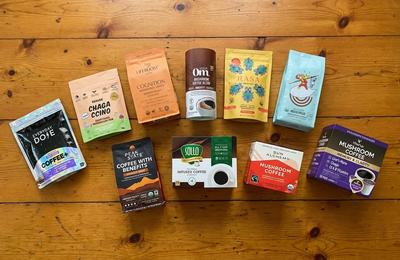
Mushroom coffee brands fall into roughly three buckets on this question. The first bucket commits to fruiting body extracts and says so prominently. The second bucket uses mycelium-on-grain and at least discloses it. The third bucket either does not disclose at all or hides the source behind generic language.
Fruiting body brands (the cleaner side)
- Four Sigmatic — explicitly markets fruiting body extracts. The founder has stated publicly that "the majority of mushroom products sold in the US for health purposes don't actually include mushrooms." Stronger formulation than RYZE on this dimension. Has its own lead-contamination history we cover in our heavy metals article.
- Everyday Dose — uses "100% fruiting body mushroom extracts" for lion's mane and chaga. Discloses no added starch, mycelium, or grain. Caveat: the total mushroom amount is hidden inside a proprietary blend that also includes collagen and L-theanine.
- Real Mushrooms — 100% fruiting body. ConsumerLab "Best Mushroom Supplement Company." Lab-verified zero grain contamination on every product. Publishes per-batch COAs showing 25-32% beta-glucan and less than 5% alpha-glucan. Not technically a coffee brand, but the industry quality benchmark.
- La Republica — "wild-grown fruiting bodies that are dual-extracted." No public COAs, but the source claim is at least specific.
Mycelium-on-grain brands (with disclosure)
- MUD\WTR — labeled as "Mushrooms and Mycelium cultured on Organic Oats and/or Organic Sorghum." Whole30 approved (which the brand cites as evidence the oats are not present in significant amounts). Discloses individual mushroom amounts (562mg per mushroom). Honest about the source, even if the source is the controversial one.
- Host Defense — Paul Stamets' brand, the original mycelium-on-grain pioneer. Not a coffee brand but the standard-bearer for the mycelium camp. Independent testing has shown 35-40% alpha-glucan and 5-7% beta-glucan, plus arsenic, lead, and cadmium above ConsumerLab's Action Levels. Stamets disputes the testing methodology.
Brands that don't make it clear
- RYZE — lists six mushrooms but does not clearly specify fruiting body vs. mycelium source on its labeling. Does not publish COAs, beta-glucan percentages, or individual mushroom amounts. The market leader is also the least transparent.
The mycelium camp's defense
We are not going to pretend the mycelium side has no argument. They have one, and it is worth understanding before you write off MOG products entirely.
The strongest version of the mycelium argument is that mycelium contains some unique bioactive compounds that fruiting bodies do not — specifically erinacines in lion's mane mycelium, which may cross the blood-brain barrier more effectively than fruiting-body hericenones. The "whole organism" approach, the argument goes, captures the full spectrum of beneficial compounds rather than artificially excluding the underground portion.
The mycelium camp also points out that the standard Megazyme beta-glucan test does not capture insoluble beta-glucans that may be present in mycelium cell walls. Their position is that fruiting-body advocates are using a test that systematically undercounts mycelium's actual bioactive content.
The Functional Mushroom Council, launched in late 2025 by a coalition of North American mushroom growers (Fungi Perfecti, M2 Ingredients, Monterey Mushrooms, Aloha Medicinals, and others), is trying to move the conversation past the binary. Their chair, Dr. Julie Daoust, has said: "The conversation should shift from 'mycelium versus fruiting body' to accurate characterization, transparent labeling, validated testing, and scientific merit."
That is the position we lean toward at Evident: source matters less than testing and disclosure. A high-quality, well-digested mycelium product with a published COA showing the actual beta-glucan content is a defensible product. A fruiting-body product without a COA is mostly an assertion. The honest answer is "show me the test result" — and then judge the product on the result, not on the source label.
How to actually buy mushroom coffee in 2026
Walk into the question with three checks:
- Does the brand specify fruiting body or mycelium-on-grain on the label? If not, that itself is a quality signal — and not a good one. Most consumers do not know the difference, so a brand that hides the source is hiding it on purpose.
- Does the brand publish a Certificate of Analysis showing beta-glucan content? The number that matters is beta-glucan percentage. Look for 15%+ on a fruiting-body product and 10%+ on a high-quality mycelium product. If the brand cannot show you a percentage, you are guessing.
- Does the brand disclose individual mushroom amounts? A proprietary blend label means the brand is not telling you. A real per-mushroom amount lets you do the math on whether the dose matches anything in the published clinical literature.
Three checks. Most mushroom coffees on the market in 2026 fail at least two of them. The one that fails all three is also the best-selling brand in the country. That is the state of the category, and it is the gap we are writing into.
Frequently Asked Questions
Fruiting body is the part of the mushroom you can see — cap, stem, gills. It is what traditional medicine has used for thousands of years and what almost all clinical studies use. Mycelium is the underground root network. In supplement manufacturing, mycelium is grown on sterilized grain (usually brown rice or oats) and then dried and ground together with the grain — they cannot be physically separated. The result is a mixture of mycelium plus rice flour or oat flour. Independent testing has shown that some "mycelium" mushroom products are 50-70% grain by weight.
Beta-glucans are the primary bioactive compound in functional mushrooms — they are responsible for most of the immune and cognitive effects studied in clinical trials. Premium fruiting body extracts test at 25-35% beta-glucan and less than 5% alpha-glucan (starch). Typical mycelium-on-grain products test at 1-7% beta-glucan and 35-40% alpha-glucan. That is the difference between 5x and 30x the bioactive content per serving. A 2017 United States Pharmacopeia study tested 19 reishi supplements and found only 5 (26%) were verified as actual reishi mushroom — the rest had a starch profile consistent with grain, not mushroom.
No, but you need testing to know. The honest answer is that source matters less than testing and disclosure. A high-quality, well-digested mycelium product with a published Certificate of Analysis showing 10%+ beta-glucan content is defensible. A fruiting body product without a COA is mostly an assertion — you have no way to verify it. The Functional Mushroom Council, launched in 2025 by major North American mushroom growers, is pushing the industry past the binary debate toward standardized testing and transparent labeling. Until that happens, the consumer-friendly rule is: show me the test result.
Four Sigmatic, Everyday Dose, La Republica, and Real Mushrooms (a supplement brand, not strictly coffee) all market fruiting body extracts. MUD\WTR uses mycelium-on-grain and discloses it openly. RYZE does not clearly specify on its labeling, which is itself a transparency red flag — most mushroom coffee buyers do not know the difference, so brands that hide the source are usually hiding it for a reason. None of the brands we've found have a perfect record on every dimension; the question is which trade-offs they are honest about.